


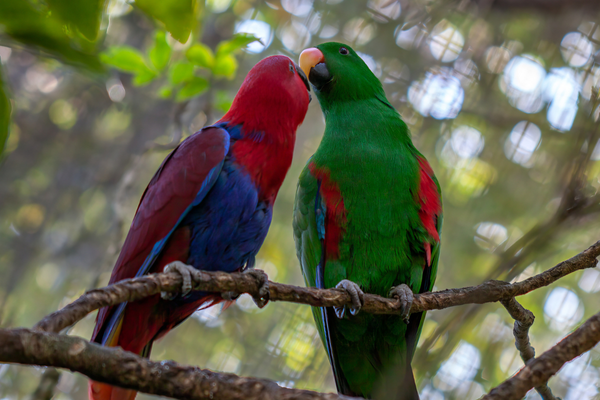
Eclectus Parrots were the subject of significant scientific confusion for over a century — the males and females look so dramatically different that early naturalists classified them as entirely separate species until their relationship was established in the late 19th century.
Eclectus Parrot
Eclectus species
Download the full care guide (PDF)
Free & Print-ready

30-40+ years

35-42cm; 400-600g

Medium


Where they come from
Natural History & Origin


Get it right early
Tips for First-Time Owners
- 1 Never feed Eclectus Parrots artificially coloured, dyed or preserved pellets or bird treats — use only natural, additive-free formulations such as a natural, dye-free, preservative-free parrot pellet or a quality natural parrot pellet; this is the single most important species-specific dietary rule.
- 2 Fresh food should make up approximately 50–60% of the total diet — more than for most parrot species. Prepare a varied selection daily and remove it within two to three hours.
- 3 Eclectus are extremely sensitive to airborne pollutants — never use non-stick cookware (PTFE/Teflon), scented candles, air fresheners, or tobacco smoke anywhere near the bird.
- 4 Males and females have similar care needs but can have different temperaments — discuss the individual bird's personality with the breeder before selecting.
- 5 Confirm licensing requirements in your state — in some states, Australian Eclectus Parrots require a fauna keeper licence as they are a native species; in other states, confirm requirements before purchasing captive-bred birds. Other subspecies generally do not require a licence.
Setting up the habitat
Enclosure & Husbandry
What to feed
Dietary Management
Day-to-day interaction
Handling & Socialisation
Find your next best friend
Browse all Handraised Birds
Our Available Handraised Birds
Did you know
Fun Facts
Eclectus Parrots have an unusually long digestive tract relative to their body size, which is an adaptation to their high-fibre, fruit-based natural diet — this is why they are uniquely sensitive to the artificial additives found in many standard commercial parrot pellets.
In the wild, female Eclectus Parrots are known to be intensely territorial of their nesting hollows — they may spend most of the year inside or near the hollow, with multiple males visiting to feed them, a mating system that is effectively polygynandrous and unique among parrots.
Keep them stimulated
Enrichment
What to watch for
Common Health Issues
Everything you need
Essentials Shopping List
Setup checklist
- Large powder-coated or stainless steel cage — minimum 100 × 75 × 150cm
- Play top or gym/play standMultiple natural timber perches of varying diameter
- Textured or rough-surface perch (near food dishes)
- Stainless steel food and water dishes (minimum two sets)
- Natural, dye-free, additive-free parrot pellets
- Extensive varied fresh fruit and vegetables (daily)
- Broad-spectrum bird wormer (quarterly)
- Minimum six rotating toys: foraging toys, foot toys, chew items, puzzle feeders
- Natural palm frond, coconut husk or dried timber chew items
- Large shallow bathing dish or fine-mist spray bottle
- Cage cover (breathable)
- Avian-safe, scent-free cage disinfectant
- Annual avian vet check (ongoing)
- Fauna keeper licence (Queensland) / confirm state requirements
READY TO SET UP
Browse all
Shop the Essentials

Avigrain Small Parrot Mix 20kg
$36.49
View →

Avigrain Budgie Blue 20kg
$52.99
View →

Budgie Mix
from$15.99
View →

Forage Gourmet Eclectus Food
from$32.99
View →

Forage Gourmet Conure & Quaker Food
from$17.99
View →

Avigrain Grey Striped Sunflower Seed 15kg
$37.99
View →

Avigrain Budgie Green Mix 20kg
$44.99
View →

Birdzone Eclectus Blend
from$29.99
View →
FAQ
Commonly Asked Questions
-
Why does my Eclectus look so different from the bird I saw in a photo?
-
Can I feed my Eclectus the same pellets I use for my other parrots?
-
Are Eclectus good talkers?
-
Do Eclectus need a licence in Australia?
-
Are Eclectus suitable for beginners?
Learn more
See more care guides Read about other species
No articles match that search. Try a different word.


Need help?Our specialists are in-store every day to help with set up, licensing and feeding.
Visit Kellyville Pets