Care Guide6 min read

Rainbow Lorikeet

Trichoglossus moluccanus
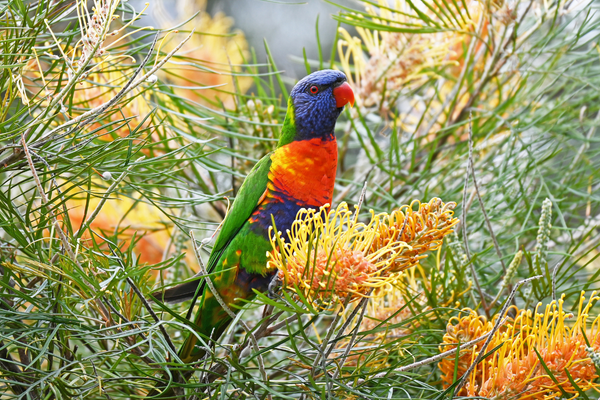
Rainbow Lory

Rainbow Lorikeet Care Guide
Lifespan
15-25+ years
Adult Size
25-30cm; 120-150g
Care Level
Medium to High
Diet

Specialist lorikeet nectar formula (wet and/or dry formula) as the dietary foundation, supplemented daily with fresh fruit and vegetables — never seed or standard parrot pellets

Enclosure

Medium-to-large powder-coated or stainless steel cage, ideally with easy-clean surfaces throughout, a nest or roosting box, and a dedicated bathing arrangement

Temperament

High energy, hilarious and among the most playful of all pet bird species. Rainbow Lorikeets are arguably the most entertaining and chaotic of commonly kept parrots

Where they come from

Natural History & Origin

The Rainbow Lorikeet is one of Australia's most familiar and abundant native parrots, found across eastern and southeastern Australia from Queensland through New South Wales, Victoria and South Australia, including Tasmania. They inhabit a very wide range of environments wherever flowering trees and shrubs are present — coastal heathland, eucalypt forest, woodland, mangroves, parks, gardens and suburban areas.

Unlike most parrots, lorikeets are nectarivores — they feed predominantly on nectar, pollen and blossoms, using a highly specialised brush-tipped tongue. They also eat soft fruits and berries. This completely different dietary system means that Rainbow Lorikeets cannot be fed standard parrot pellets or seed-based diets and require specially formulated lorikeet nectar products.

Rainbow Lorikeets are high energy, hilarious and among the most playful of all pet bird species. They are one of the best talkers of birds their size. They are also notably messy — their liquid nectar-based diet results in wet, liquid droppings that require very regular cage cleaning. Keeping a lorikeet is a rewarding experience for keepers who embrace their chaotic, high-energy personality.

As a native Australian bird, the Rainbow Lorikeet requires a fauna keeper licence in all states and territories. Source only from licensed captive breeders.

Get it right early

Tips for First-Time Owners

  1. 1 The single most important rule of lorikeet keeping is nectar hygiene — change nectar at least once daily, and twice daily in warm weather. Contaminated nectar causes serious illness rapidly. Never let nectar sit in a cage for more than 12–24 hours.
  2. 2 Prepare your cleaning routine before you get a lorikeet — their liquid diet produces liquid droppings that require the cage floor and perches to be cleaned daily. Newspaper cage liners changed daily make this manageable.
  3. 3 Always provide a roosting box in the cage — Rainbow Lorikeets use a nest box year-round for sleeping, not only for breeding.
  4. 4 Never feed standard parrot seed or pellets as the dietary foundation — lorikeet nectar formula is the only appropriate dietary base for this species.
  5. 5 In NSW, no keeper licence is required for a Rainbow Lorikeet — they are an exempt native species. Requirements vary in other states — confirm with your state wildlife authority and source from a licensed captive breeder.
Setting up the habitat

Enclosure & Husbandry

Rainbow Lorikeets are active, acrobatic birds and need a generously sized, easy-to-clean enclosure. Due to their liquid diet and corresponding liquid droppings, the cage and surrounding area will require very frequent cleaning — this is the most significant practical consideration in lorikeet keeping. Easy-clean cage flooring, removable trays and wipeable surfaces should be prioritised in cage selection.

Minimum cage dimensions for a single adult are 90cm W × 50cm D × 90cm H; larger is strongly preferred. Bar spacing of 1.5–2 cm is appropriate. Stainless steel or powder-coated construction is recommended. A nest or roosting box inside the cage is important — Rainbow Lorikeets use a roosting box year-round for sleeping, not only for breeding.

Provide multiple perches of varying diameter, including natural timber branches from native species (eucalyptus, grevillea, bottlebrush) that provide foraging interest. A play top or separate gym stand facilitates out-of-cage time. Lorikeets love to bathe — a large, shallow water dish or daily gentle misting is essential and enthusiastically received. Cover at night with a breathable cover. An outdoor aviary of at least 3.6m L × 1.2m W × 2m H is the gold standard for Rainbow Lorikeet housing, providing flight exercise, natural sunlight and a more practical approach to the mess their diet creates.

What to feed

Dietary Management

Rainbow Lorikeets have a completely different digestive system from seed-eating parrots. Their brush-tipped tongues and shorter digestive tract are adapted for nectar and pollen, not seeds. Never feed Rainbow Lorikeets standard seed mixes or dry parrot pellets as a dietary staple — these are inappropriate for their digestive anatomy and can cause serious health problems.

The dietary foundation should be a commercially produced lorikeet nectar formula, available in both dry (powder mixed with water) and wet (pre-moistened) forms. Offer both forms in separate dishes if possible, particularly for young birds. Follow the manufacturer's mixing instructions carefully — excess water increases spoilage risk. Nectar must be changed at least twice daily in warm weather and once daily in cool weather, as it spoils rapidly and contaminated nectar causes severe illness.

Supplement daily with fresh fruit — apple (seeds removed), pear, mango, fig, rockmelon, grapes, berries and papaya — and vegetables such as corn, peas, carrot, broccoli and leafy greens. Never feed lettuce, avocado, apple seeds or any processed human food. Vitamin supplements such as a quality bird vitamin supplement can be added to water two to three times per week. Fresh water must be changed daily — lorikeets need separate clean water for drinking as their nectar dishes are not suitable for hydration alone.

Day-to-day interaction

Handling & Socialisation

Rainbow Lorikeets they approach life at full speed, hanging upside down, chasing toys, playing with water and engaging their owners with uninhibited enthusiasm. They are one of the best talkers of birds their size and can develop clear, contextually appropriate speech. They can also be loud, particularly at dawn and dusk.

They are generally very receptive to handling when raised as hand-raised birds. They are curious, confident and will often step up readily. Handle daily and with consistency — lorikeets that are not handled regularly can become nippy. Their beak is relatively small but they can bite when over-stimulated or startled.

Out-of-cage time of at least one to two hours daily is important. Lorikeets are highly active and benefit greatly from flight exercise and environmental exploration. Be aware that they will attempt to investigate and potentially destroy anything within reach during free-roaming time — clear the environment of hazards. Bathing is a major source of joy for lorikeets — a shallow dish on the play gym or floor during out-of-cage time is irresistible to most individuals.

Did you know

Fun Facts

Rainbow Lorikeets have a brush-tipped tongue — covered in papillae that form a bristle-like structure — that can dart in and out of flowers up to ten times per second, allowing efficient extraction of nectar and pollen from even tightly packed blossoms.

They have been documented becoming mildly intoxicated by fermenting nectar in the wild, with affected birds displaying uncoordinated flight and unusual boldness — a phenomenon so common in Australia it prompted the establishment of a wildlife 'drunk tank' in Darwin to care for affected birds during flowering seasons.

Wild Rainbow Lorikeets are known to form pair bonds that last for life — captive pairs engage in elaborate mutual preening and food-sharing behaviour that closely mirrors the affectionate bonding behaviour observed in wild flock members.

Keep them stimulated

Enrichment

Rainbow Lorikeets need rich daily enrichment to match their high energy and intelligence. Rotate toys every few days — swings, bells, foraging toys, puzzle feeders and chew items. Offer fresh native branches from eucalyptus, grevillea and bottlebrush, which provide chewing, foraging and environmental interest simultaneously. Hide food items in foraging toys, wrap fruit in paper or present nectar in novel foraging containers to encourage problem-solving.

Water play is a natural and highly enriching activity — a large shallow dish or gentle hand misting provides sensory stimulation and satisfies the species' natural daily bathing instinct. Trick training with positive reinforcement is effective and entertaining with this species — Rainbow Lorikeets learn quickly and respond well to a structured reward-based training programme. Social inclusion in household activity is itself a form of enrichment for these highly gregarious birds.

What to watch for

Common Health Issues

Nectar spoilage and bacterial crop infection: The most common and serious health issue in captive lorikeets. Nectar must be changed at minimum twice daily in warm weather — stale or contaminated nectar causes rapid crop infection and severe illness. Strict nectar hygiene is the most important preventative measure.

Haemochromatosis (iron storage disease): Lorikeets evolved to extract maximum iron from the naturally low-iron pollen and nectar of their wild diet, making them highly efficient iron absorbers — a trait that becomes dangerous in captivity when high-iron foods are offered. Excess iron accumulates in the liver, causing progressive and often fatal damage. A specialised low-iron lorikeet diet is essential; avoid fruit juice, honey-based mixes and high-iron commercial nectars.

Psittacosis (Chlamydiosis): Annual vet checks and good hygiene are preventative.

Calcium deficiency: Can occur with an inadequate diet — ensure the nectar formula is nutritionally complete and supplement with appropriate foods.

PBFD (Psittacine Beak and Feather Disease): Source from reputable, tested breeders. Respiratory infections: Maintain good cage ventilation and hygiene.

Feather Destructive Behaviour: Can develop with insufficient enrichment — lorikeets require very high levels of daily stimulation.

Everything you need

Essentials Shopping List

Setup checklist

  • Medium-to-large cage — minimum 90 × 50 × 90 cm; outdoor aviary (3.6m L × 1.2m W × 2m H) strongly recommended
  • Easy-clean cage liner (newspaper — changed daily)
  • Roosting/nest box (essential — used year-round)
  • Multiple natural timber perches (eucalyptus, grevillea, bottlebrush)
  • Stainless steel food and water dishes (minimum three sets for nectar, water, fresh food)
  • Lorikeet nectar formula — wet and dry
  • Varied fresh fruit (daily)
  • Fresh vegetables (daily)
  • Vitamin supplement (a quality bird vitamin supplement)
  • Broad-spectrum bird wormer (quarterly)
  • Large shallow bathing dish
  • Fine-mist spray bottle
  • Rotating toy selection: swings, bells, foraging toys, chew items
  • Fresh native branches (eucalyptus, grevillea, bottlebrush)
  • Waterproof floor mat or easy-clean surface around cage
  • Breathable cage cover
  • Avian-safe disinfectant
  • Annual avian vet check (ongoing)
  • Fauna keeper licence (all states and territories)
FAQ

Commonly Asked Questions

  • Why can't I feed my lorikeet regular parrot pellets?

    Lorikeets have a specialised digestive system adapted for liquid nectar and pollen. Their gizzard is less muscular than seed-eating parrots and their gut is shorter — standard pellets and seed are nutritionally inappropriate and difficult to digest properly.

  • How often do I need to change the nectar?

    At minimum once daily; twice daily in warm weather. Nectar spoils rapidly and contaminated nectar is the leading cause of serious illness in captive lorikeets. This is non-negotiable.

  • Do I need a roosting box?

    Yes. Rainbow Lorikeets sleep in enclosed roosting spaces year-round and experience genuine stress without this. Provide a nest/roost box in the cage at all times.

  • Are Rainbow Lorikeets noisy?

    Yes — their contact calls are loud and carry well, particularly at dawn and dusk. This is a species-specific characteristic and should be considered carefully for apartment or close-neighbour living situations.

  • Do I need a licence to keep a Rainbow Lorikeet in Australia?

    In NSW, Rainbow Lorikeets are one of the native species exempt from keeper licence requirements — no licence is needed. Requirements vary in other states and territories — confirm with your state wildlife authority before purchasing.

Need help?

Our specialists are in-store every day to help with setup, licensing and feeding.

Visit Kellyville Pets →