


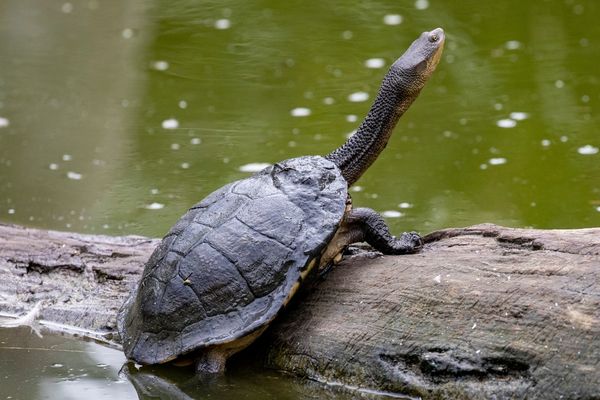
The Eastern Long-Neck Turtle belongs to the suborder Pleurodira — the 'side-necked' turtles — which fold the neck sideways rather than retracting straight back into the shell. This is a fundamental anatomical distinction from Northern Hemisphere turtle species.
Eastern Long-Neck Turtle
Chelodina longicollis
Download the full care guide (PDF)
Free & Print-ready

20-50+ years

15-26cm

Medium to High


Where they come from
Natural History & Origin

Get it right early
Tips for First-Time Owners
- 1 Invest in the best canister filter you can afford — water quality is the foundation of turtle health, and an undersized or poor-quality filter is the single most common cause of illness in captive turtles.
- 2 Test water parameters weekly — ammonia and nitrite spikes can cause serious illness very quickly and may not be visible to the eye.
- 3 Replace the UVB lamp annually on schedule — UVB output degrades long before the bulb visibly fails, and insufficient UVB leads to metabolic bone disease and shell problems over time.
- 4 Wash hands thoroughly with soap and water after every interaction with your turtle, its enclosure or its water — turtles can carry Salmonella without showing any signs.
- 5 Obtain the appropriate fauna keeper licence for your state before purchasing and source animals only from a licensed captive breeder.
Setting up the habitat
Enclosure & Husbandry
What to feed
Dietary Management
Day-to-day interaction
Handling & Socialisation
Did you know
Fun Facts
They can absorb oxygen from the water through highly vascularised membranes in their cloaca — a process known as cloacal bursae breathing — allowing them to remain submerged for extended periods, or even survive buried in mud during drought.
During periods of drought or when searching for a new waterhole, Eastern Long-Necks are capable of travelling several kilometres overland — a remarkable feat for a primarily aquatic animal.
Keep them stimulated
Enrichment
What to watch for
Common Health Issues
Everything you need
Essentials Shopping List
Setup checklist
- Large aquarium — minimum 300 litres / 120 × 50 × 50 cm for one adult
- External canister filter (rated to minimum 2× tank volume)
- Submersible aquarium heater with protective guard
- Thermometer (water temperature)
- Dry basking platform with access ramp
- Basking heat lamp and dome fitting
- Surface thermometer or temperature gun (basking spot)
- T5 10% UVB lamp and fitting
- Lighting timer
- Water quality test kit (ammonia, nitrite, nitrate, pH)
- Water conditioner/dechlorinator
- Siphon or gravel vacuum (for water changes)
- Fine river sand or bare-bottom setup
- Submerged hides (PVC elbows or flat rocks)
- Aquatic plants (live or artificial)
- Feeder fish supply or frozen bloodworms
- Reptile-safe aquarium disinfectant
- Fauna keeper licence (state-specific)
READY TO SET UP
Browse all
Shop the Essentials

Live Black Soldier Fly Larvae
from$11.49
View →

Live Woodies - Pisces Enterprises
from$12.99
View →

Live Earthworms - Approx. 100g
$14.99
View →

Live Silkworms
from$16.99
View →

Live Crickets - Bio Supplies - Standard Tub
$6.99
View →

Save 20%
Reptile One Dome Reflector

Live Giant Mealworms
from$8.49
View →

Save 20%
Exo Terra Reptile UVB Light
FAQ
Commonly Asked Questions
-
How often should I change the water?
-
Can I keep a long-neck turtle in an outdoor pond?
-
My turtle hasn't eaten in over a week — should I be concerned?
-
Do turtles carry diseases that can affect people?
-
Is a licence required to keep an Eastern Long-Neck Turtle in Australia?
Learn more
See more care guides Read about other species
No articles match that search. Try a different word.

Reptiles
How to Keep Crickets Alive Longer (and Gut-Load Them Properly)
Read
Reptiles
How to Source a Pet Reptile in NSW: Where to Buy and Red Flags to Avoid
Read
Reptiles
Found a Snake in Your Backyard? Here's What to Do (and Who to Call)
Read
Reptiles
Why Won't My Bearded Dragon Eat? Common Causes and What to Do
Read
Reptiles
Can You Keep a Salamander as a Pet in Australia? The Axolotl Story
Read
Reptiles
Why Is My Bearded Dragon Sluggish? Lethargy Causes and Solutions
Read
Need help?Our specialists are in-store every day to help with set up, licensing and feeding.
Visit Kellyville Pets