


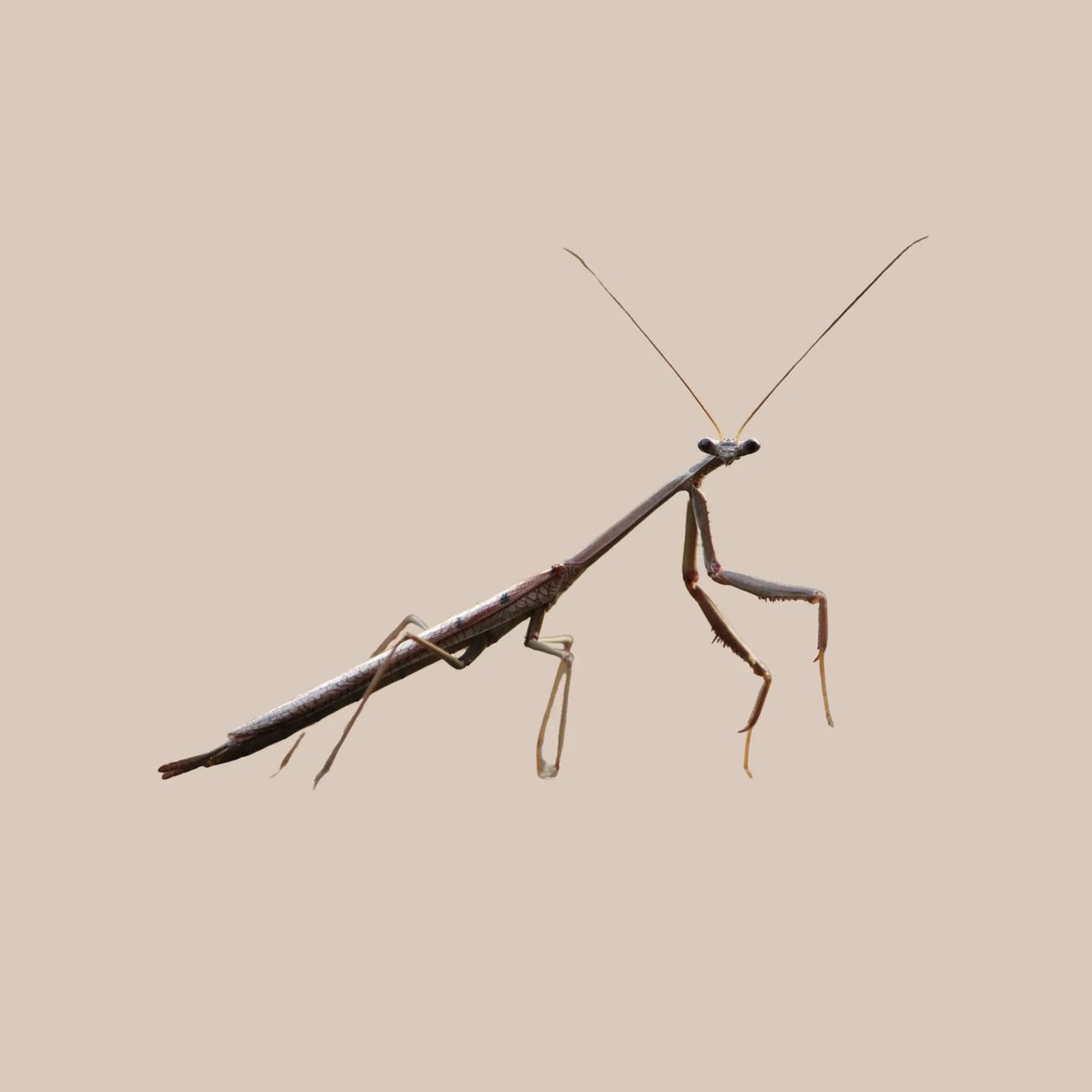
Praying Mantis
Various species
Download the full care guide (PDF)
Free & Print-ready

Adult lifespan: 6-9 months

up to 12cm

Low to Medium


Where they come from
Natural History & Origin

Get it right early
Tips for First-Time Owners
- 1 Enclosure height is the most critical dimension: at minimum 3 times the mantis's body length of clear vertical space below the ceiling for safe moulting. Measure your mantis and check the enclosure before each moult.
- 2 Remove ALL live prey from the enclosure immediately when a moult begins: a single cricket in the enclosure can injure or kill a moulting mantis and cause permanent deformities.
- 3 House mantises individually after the 3rd moult — there are no exceptions to this rule. Even well-fed mantises of the same species will eat each other.
- 4 Cool temperatures (within the appropriate range) extend lifespan; warm temperatures shorten it. The natural lifespan of a mantis is fixed at a certain number of moults, not a calendar duration — slower metabolism means more calendar time between moults and a longer life.
- 5 A mantis refusing food for several days is almost certainly preparing to moult, not ill. Fast for 3-5 days before a moult is normal; remove all prey and wait.
Setting up the habitat
Enclosure & Husbandry
What to feed
Dietary Management
Day-to-day interaction
Handling & Socialisation
Find your next best friend
Browse all Critters
Our Available Critters


Did you know
Fun Facts
The praying mantis is the only insect known to possess true stereo (binocular) vision: the positioning and structure of its large, forward-facing compound eyes creates genuine parallax-based depth perception, allowing it to judge distances with remarkable precision during prey strikes — a visual system convergently evolved with vertebrate eyes.
During mating in many species including H. majuscula, the female frequently consumes the male — starting with the head — while mating is still in progress. The male continues to mate for minutes or hours after decapitation, as the nerve ganglia controlling mating behaviour are located in the abdomen rather than the head. The female's body nutrients from consuming the male enhance the development of the eggs she will subsequently lay.
Despite their fearsome reputation, mantises can be preyed upon by bats — and have evolved an ultrasound-detecting organ in the centre of their thorax (rather than in a paired structure as in most hearing insects) that allows them to detect bat sonar mid-flight and execute an evasive aerial spiral dive before being caught.
Keep them stimulated
Enrichment
What to watch for
Common Health Issues
Everything you need
Essentials Shopping List
Setup checklist
- Ventilated plastic or mesh enclosure (minimum height = 3x mantis body length)
- Mesh or perforated lid (essential for moulting grip)
- Climbing branches and twigs at varying heights
- Thin coconut peat or paper towel substrate
- Misting bottle (daily use)
- Digital thermometer and hygrometer
- Heat mat and thermostat (cooler climates or winter)
- Feeding forceps (long, blunt-tipped)
- Live prey: crickets, small woodies, blowflies (appropriate size for instar)
- Live fruit flies (Drosophila) for early nymphs
- Separate enclosures for each individual (essential from 3rd moult)
- Reptile-safe disinfectant for periodic enclosure cleaning
READY TO SET UP
Browse all
Shop the Essentials

Springtails Clean Up Crew
from$16.49
View →

Isopod Clean Up Crew
from$17.49
View →

Live Silkworms
from$16.99
View →

Save 20%
Reptile One Central Australian Desert Sand

Pisces Aqua Load
$26.99
View →

Live Crickets - Bio Supplies - Standard Tub
$6.99
View →

Critter's Comfort Fine 20L - Previously Kritter's Crumble
$29.99
View →

Critter's Comfort Coarse 20L - Previously Kritter's Crumble
$29.99
View →
FAQ
Commonly Asked Questions
-
Can I keep two mantises together?
-
Why has my mantis stopped eating?
-
How do I know if my mantis is a male or female?
-
My mantis fell during its moult and is deformed.
-
Do I need a licence to keep a mantis in Australia?
Learn more
See more care guides Read about other species
No articles match that search. Try a different word.


Need help?Our specialists are in-store every day to help with set up, licensing and feeding.
Visit Kellyville Pets