


The Woma Python holds deep significance in Central Australian Aboriginal culture. In Anangu cosmology, the ancestral being Kuniya — a Woma Python woman — fought a battle against Liru the King Brown Snake man at Uluru. The marks of this battle are said to be visible in the rock formations at Mutitjulu Waterhole, one of the most sacred sites in Uluru-Kata Tjuta National Park.
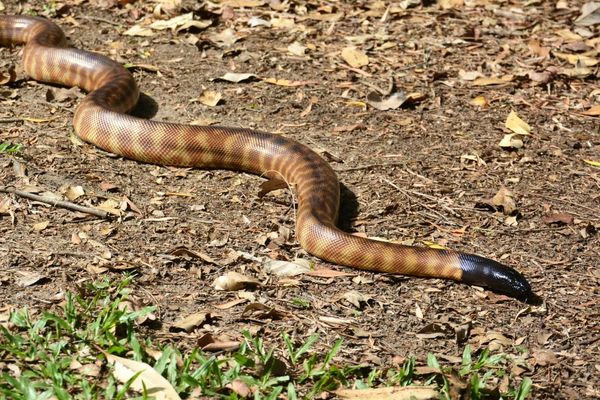
Woma and Black-Headed Pythons
Aspidites species
Download the full care guide (PDF)
Free & Print-ready

20-30+ years

up to 2m

Medium


Where they come from
Natural History & Origin


Get it right early
Tips for First-Time Owners
- 1 Deep burrowing substrate is non-negotiable for both species: a minimum of 10-15 cm (Woma) or 15-20 cm (Black-headed Python) of appropriate, compactable substrate must be provided. A snake denied the ability to burrow is chronically stressed.
- 2 Always use feeding tongs of adequate length and remove them immediately after the snake strikes — both species have strong feeding responses, and Womas in particular have been documented swallowing implements presented alongside prey.
- 3 Always use a hook or stick to signal handling versus feeding before lifting: consistent use of this cue significantly reduces defensive and feeding-response strikes and should be maintained throughout the life of the animal.
- 4 Plan the adult enclosure size before purchasing, particularly for Black-headed Pythons: a minimum 180cm enclosure is needed for adults and 200cm or more is strongly recommended. Never purchase on the basis of juvenile size.
- 5 A fauna keeper licence is required in all Australian states and territories for both species. Confirm the specific licence class with your state wildlife authority and source only from a licensed captive breeder.
Setting up the habitat
Enclosure & Husbandry
What to feed
Dietary Management
Day-to-day interaction
Handling & Socialisation
Find your next best friend
Browse all Pythons
Our Available Pythons
Did you know
Fun Facts
Both Aspidites species completely lack the heat-sensing labial pits found in every other python genus worldwide. Both species represent the earliest-diverging lineage of all living pythons — in evolutionary terms, they are the sister group to all other python species combined, making them living representatives of the oldest python lineage on Earth.
Black-headed Pythons are immune to the venom of Australian snakes and actively prey on some of the world's most venomous species, including brown snakes, tiger snakes and death adders. The glossy black head also serves a thermoregulatory function: its dark pigmentation absorbs solar radiation far more efficiently than the banded body, allowing the snake to warm its brain and sensory organs rapidly by extending just the head from a burrow while keeping the rest of the body sheltered underground.
Keep them stimulated
Enrichment
What to watch for
Common Health Issues
Everything you need
Essentials Shopping List
Setup checklist
- Secure enclosure: Woma Python — minimum 120 x 60 x 45 cm for adults; 150 x 60 x 45 cm for snakes over 1.5 m Black-headed Python — minimum 180 x 60 x 60 cm; 200 x 60 x 60 cm or larger for large adults
- Deep burrowing substrate (10-15 cm Woma; 15-20 cm Black-headed Python) — sandy loam, red desert sand mix, aspen shavings or coconut coir/sand blend
- Under-tank heat mat or heat cord (primary heat source for both species)
- Ceramic heat emitter (secondary overhead warmth — particularly useful for Black-headed Pythons)
- Quality thermostat — proportional or pulse (essential for both species)
- Digital thermometers (minimum two — warm and cool ends)
- Temperature gun / infrared thermometer (daily hot spot verification)
- Hides — minimum two snug enclosed hides per enclosure (warm and cool ends)
- Ceramic or glass water bowl (Woma); heavy ceramic or stainless steel soaking bowl (Black-headed Python)
- Snake hook (essential pre-handling cue for both species)
- Feeding tongs (minimum 30-40 cm for Woma; 40-50 cm for Black-headed Python)
- Pre-killed or frozen-thawed rodents (mice for juveniles; rats for adults)
- Reptile-safe enclosure disinfectant
- Hygrometer (humidity monitoring during shed cycles)
- Damp hide or spray bottle (shed-cycle humidity assistance)
- Reptile-experienced veterinarian (annual faecal check recommended)
- Fauna keeper licence — class varies by species and state; confirm requirements with your state wildlife authority
READY TO SET UP
Browse all
Shop the Essentials

Springtails Clean Up Crew
from$16.49
View →

Isopod Clean Up Crew
from$17.49
View →

Save 20%
Reptile One Dome Reflector

Frozen Rats
from$17.99
View →

Critter's Comfort Fine 20L - Previously Kritter's Crumble
$29.99
View →

Save 20%
Exo Terra Reptile UVB Light

Critter's Comfort Coarse 20L - Previously Kritter's Crumble
$29.99
View →

F10 Veterinary Disinfectant - 200mL
$39.99
View →
FAQ
Commonly Asked Questions
-
What licence do I need to keep an Aspidites python in Australia?
-
Which species is better for an intermediate keeper — the Woma or the Black-headed Python?
-
Why is my Aspidites python always buried?
-
Are Aspidites pythons venomous?
-
How do I differentiate the two species?
Learn more
See more care guides Read about other species
No articles match that search. Try a different word.


Need help?Our specialists are in-store every day to help with set up, licensing and feeding.
Visit Kellyville Pets