


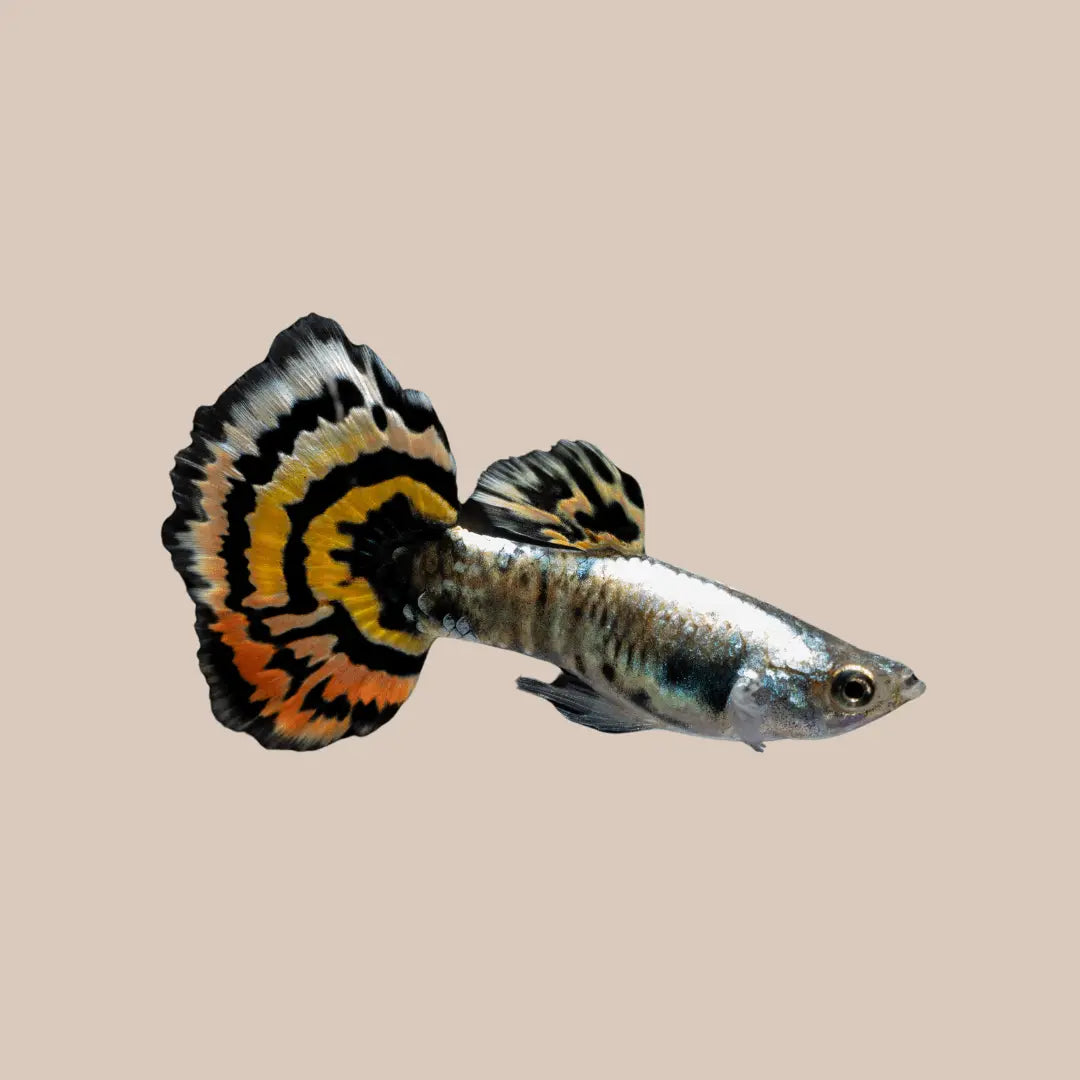
Male Guppies
Poecilia reticulata
Guppies Common Name: Guppy
Guppies Size: 4- 7.6cm
Guppies Diet: Omnivore
Guppies Water Type: Fresh
Guppies Optimum pH Level: 7.0-7.8
Guppies Life Span: 2-4 years
Guppies Origin:
The guppy is a small colourful species of freshwater tropical fish that is found naturally in the rivers and lakes of South America. There are nearly 300 different types of guppy spread throughout Barbados, Brazil, Guyana, Netherlands Antilles, Trinidad and Tobago, and Venezuela.
The guppy is one of the most popular types of aquarium tropical fish in the world as they are small, colourful and easier to keep than many other species of fish. The guppy generally lives from 3 to 5 years old in captivity and slightly less in the wild.
Guppies Sexing:
The female guppy and the male guppy can be identified quite easily as the female guppy has a small, patterned tail where the tail of the male guppy is much longer and generally has fewer markings. The female guppy also tends to be larger in size than the male guppy.
Guppies Breeding:
Guppies have the mating system called polyandry, where females mate with multiple males. Multiple mating is beneficial for males because the males' reproductive success is directly related to how many times they mate. The cost of multiple mating for males is very low because they do not provide material benefit to the females or parental care to the offspring. Conversely, multiple mating can be disadvantageous for females because it reduces foraging efficiency and increases the chances of predation and parasitic infection. However, females gain some potential benefits from multiple mating. For example, females that mate multiply are found to be able to produce more offspring in shorter gestation time, and their offspring tend to have better qualities such as enhanced schooling and predator evasion abilities.
Female guppies mate again more actively and delay the development of a brood when the anticipated second mate is more attractive than the first male. Experiments show that remating females prefer a novel male to the original male or a brother of the original male with similar phenotypes.
Choose options
Poecilia reticulata
Guppies Common Name: Guppy
Guppies Size: 4- 7.6cm
Guppies Diet: Omnivore
Guppies Water Type: Fresh
Guppies Optimum pH Level: 7.0-7.8
Guppies Life Span: 2-4 years
Guppies Origin:
The guppy is a small colourful species of freshwater tropical fish that is found naturally in the rivers and lakes of South America. There are nearly 300 different types of guppy spread throughout Barbados, Brazil, Guyana, Netherlands Antilles, Trinidad and Tobago, and Venezuela.
The guppy is one of the most popular types of aquarium tropical fish in the world as they are small, colourful and easier to keep than many other species of fish. The guppy generally lives from 3 to 5 years old in captivity and slightly less in the wild.
Guppies Sexing:
The female guppy and the male guppy can be identified quite easily as the female guppy has a small, patterned tail where the tail of the male guppy is much longer and generally has fewer markings. The female guppy also tends to be larger in size than the male guppy.
Guppies Breeding:
Guppies have the mating system called polyandry, where females mate with multiple males. Multiple mating is beneficial for males because the males' reproductive success is directly related to how many times they mate. The cost of multiple mating for males is very low because they do not provide material benefit to the females or parental care to the offspring. Conversely, multiple mating can be disadvantageous for females because it reduces foraging efficiency and increases the chances of predation and parasitic infection. However, females gain some potential benefits from multiple mating. For example, females that mate multiply are found to be able to produce more offspring in shorter gestation time, and their offspring tend to have better qualities such as enhanced schooling and predator evasion abilities.
Female guppies mate again more actively and delay the development of a brood when the anticipated second mate is more attractive than the first male. Experiments show that remating females prefer a novel male to the original male or a brother of the original male with similar phenotypes.
Poecilia reticulata
Guppies Common Name: Guppy
Guppies Size: 4- 7.6cm
Guppies Diet: Omnivore
Guppies Water Type: Fresh
Guppies Optimum pH Level: 7.0-7.8
Guppies Life Span: 2-4 years
Guppies Origin:
The guppy is a small colourful species of freshwater tropical fish that is found naturally in the rivers and lakes of South America. There are nearly 300 different types of guppy spread throughout Barbados, Brazil, Guyana, Netherlands Antilles, Trinidad and Tobago, and Venezuela.
The guppy is one of the most popular types of aquarium tropical fish in the world as they are small, colourful and easier to keep than many other species of fish. The guppy generally lives from 3 to 5 years old in captivity and slightly less in the wild.
Guppies Sexing:
The female guppy and the male guppy can be identified quite easily as the female guppy has a small, patterned tail where the tail of the male guppy is much longer and generally has fewer markings. The female guppy also tends to be larger in size than the male guppy.
Guppies Breeding:
Guppies have the mating system called polyandry, where females mate with multiple males. Multiple mating is beneficial for males because the males' reproductive success is directly related to how many times they mate. The cost of multiple mating for males is very low because they do not provide material benefit to the females or parental care to the offspring. Conversely, multiple mating can be disadvantageous for females because it reduces foraging efficiency and increases the chances of predation and parasitic infection. However, females gain some potential benefits from multiple mating. For example, females that mate multiply are found to be able to produce more offspring in shorter gestation time, and their offspring tend to have better qualities such as enhanced schooling and predator evasion abilities.
Female guppies mate again more actively and delay the development of a brood when the anticipated second mate is more attractive than the first male. Experiments show that remating females prefer a novel male to the original male or a brother of the original male with similar phenotypes.
What's included with your Fish from Kellyville Pets
-

Healthy and ethical breeding
-

7 day health guarantee
-

Staff support and follow-up
-

Lifetime rehoming


Species Care Guide
Learn more about this (and other) species! Our guides include top tips, fun facts, commonly asked questions and everything you need to know to get started with these amazing creatures as pets!