


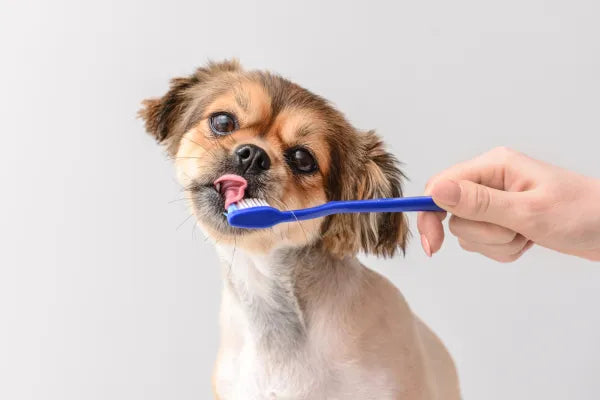
Most people who give up on brushing their dog's teeth gave up on day one. They bought a brush, went straight in with it, got a dog who twisted away and a bit of blood on the bristles, and reasonably concluded that this was not going to work.
The problem was never the dog. It was starting at step ten.
Brushing is still the best thing you can do for your dog's mouth - nothing else removes plaque as thoroughly - and almost any dog will accept it if you build up to it over a few weeks instead of a few minutes. Here is how.
Get the right gear first
A dog toothbrush. Either a finger brush that slips over your fingertip, or a long dual-ended brush with a small head at one end for the front teeth and a bigger one for the back. Finger brushes are gentler for starting out. A soft child's toothbrush works if that is what you have.
Pet toothpaste. This is not optional and you cannot substitute human toothpaste. Ours contains fluoride, which dogs should not swallow, and many contain xylitol, which is genuinely toxic to dogs. Pet toothpaste is enzymatic, safe to swallow, and flavoured like poultry or malt so most dogs treat it as a treat.
A few small high-value treats, for the training phase.
The five-week build-up
Keep every session short and finish while your dog is still relaxed rather than pushing until they pull away. If a session goes badly, drop back a step rather than repeating it.
| Week | What you are doing | Session length |
|---|---|---|
| 1 | Touch the muzzle and lips, lift a lip briefly, treat. Nothing in the mouth. | 10 seconds, twice a day |
| 2 | Slide a finger along the outside of the gums and teeth, treat. | 20 seconds |
| 3 | Let them lick pet toothpaste off your finger, then rub a little onto the gums. | 30 seconds |
| 4 | Toothpaste on a finger brush or a square of damp gauze. Two or three teeth only. | 30 seconds |
| 5 | Brush proper. A few more teeth each session until you have the whole mouth. | 60 seconds |
Five weeks sounds slow. It is a fortnight of effort spread across a month and a bit, and the payoff is a dog who lets you do this for the next decade.
Where to actually put the brush
The outside surfaces only. Plaque builds up on the cheek-facing side of the teeth, and dogs largely keep the tongue-facing surfaces clean themselves. Trying to get inside the mouth is where most of the struggle comes from and it buys you very little.
Angle the bristles at about 45 degrees to the gum line, not flat against the tooth. The gum line is where periodontal disease starts, so that junction is the target.
Small circular motions, working from front to back.
Prioritise the back teeth and the canines. The upper back molars and premolars are where tartar accumulates fastest and they are the teeth most owners never reach. If you only manage half the mouth, make it that half.
Thirty seconds a side is a real, useful clean. You are not aiming for a dental hygienist's job.
Position matters more than people think
Do not stand over your dog and reach down at their face. From a dog's point of view that is looming, and looming over a nervous dog while grabbing their head is how you get a flinch.
Sit or kneel beside them, facing the same direction, with their body against yours. Bring your hand up under the muzzle rather than down over it. For small dogs, sitting them in your lap facing away from you works well. Never clamp the head still - if they want to move away, let them, and try again later.
How often is enough?
Daily is the goal, because plaque starts turning into tartar within a couple of days and once it hardens a brush will not shift it. Three times a week still makes a substantial difference.
Consistency beats intensity every time. A quick thirty seconds most evenings does more than a thorough scrub once a fortnight, and it is far easier to keep up. Attach it to something you already do, like the last walk of the day or the evening feed.
If your dog genuinely will not have it
Some dogs will not, and a few should not. A dog with painful gums is not being difficult, it is telling you its mouth hurts, and pushing through that will make the next attempt harder.
Stop and reconsider if you see bleeding gums beyond a tiny spot in the first week or two, obvious pain when you touch a particular area, a loose or broken tooth, or a smell strong enough to make you turn your head. Any of those means a vet check before a brushing routine.
For the dogs who simply refuse, you still have decent options. A dental diet does real mechanical work with no effort from you. A water additive slows plaque build-up passively. Dental chews add abrasion. None of them match brushing, but a dog on all three is in far better shape than one on a plan you abandoned.
Where to start today
Pick up a finger brush and a tube of pet toothpaste, and spend ten seconds tonight just lifting your dog's lip and handing over a treat. That is week one done. Come and see us if you want a hand choosing a brush size for your dog's mouth, or bring them in and we will show you the grip.


