


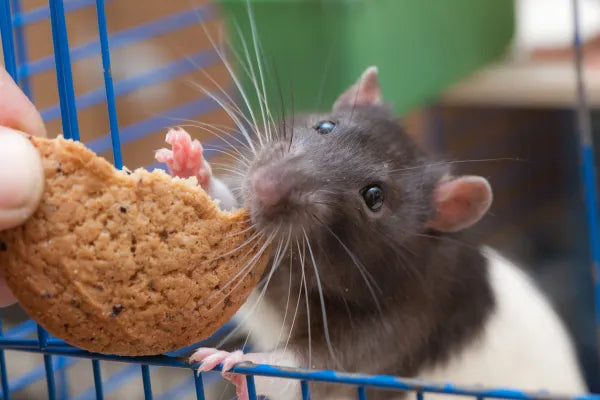
Small rodents get a lot of oversimplified dental advice. The line you hear most is that their teeth never stop growing, so give them something to chew or the teeth will grow into their jaw. Half right, and the half that is wrong leads people to buy the wrong things.
Here is what is actually going on with mouse and rat teeth, and what genuinely helps.
Only the front teeth grow forever
Rabbits and guinea pigs have continuously growing teeth all the way to the back of the mouth. Mice and rats do not. Their four front incisors grow throughout life, but the molars behind them are rooted and finished growing, exactly like ours.
That single difference changes the whole care plan. Rabbits need hay to grind their back teeth. Mice and rats do not need hay for dental reasons at all. What they need is something worth gnawing on, to manage the front teeth.
| Species | Front incisors | Back molars | What they need |
|---|---|---|---|
| Mouse | Grow continuously | Rooted, do not grow | Things to gnaw, plus enough enrichment to stop bar chewing |
| Rat | Grow continuously | Rooted, do not grow | Things to gnaw, ideally varied and rotated |
| Rabbit / guinea pig | Grow continuously | Grow continuously | Unlimited long-stem hay, all day |
They mostly manage their own incisors
Healthy mice and rats grind their upper and lower incisors against each other, a behaviour called bruxing. It keeps the teeth sharp and the right length automatically, and it happens whether or not you give them anything to chew.
Which means most incisor overgrowth in these species is not caused by a lack of chew toys. It is caused by malocclusion - the teeth being misaligned so they cannot wear against each other properly. That usually comes from genetics, or from injury, and a common source of injury is a pet that chews the cage bars obsessively because it is bored.
So the honest version is this. Chews matter, but mainly as enrichment and as a way to stop the destructive habits that damage teeth in the first place. A rat with plenty to do is far less likely to spend its evenings gnawing metal.
What is actually worth buying
Good options, and easy to rotate so they stay interesting:
- Untreated hardwood gnaw blocks
- Apple, willow and other safe fruitwood sticks
- Seagrass and loofah chews
- Plain cardboard - toilet rolls, egg cartons, boxes with tape and printed ink removed
- Mineral and lava chews
- The occasional whole nut in its shell, for rats especially, though sparingly because they are high in fat
- Compressed hay cubes, useful as a chew even though mice and rats do not need hay dentally
Things that get sold as dental products and do very little:
- Hard moulded plastic chews. Most rodents ignore them, and the ones that do not can splinter off pieces.
- Brightly painted wooden toys with unlisted finishes. If you cannot find out what the paint or dye is, do not buy it.
- Salt licks marketed as tooth care. They are a mineral supplement, not a dental product, and most rodents on a good diet do not need one.
- Softwood shavings such as pine and cedar. Beyond the dental question these carry aromatic oils that irritate small rodent airways. Use paper-based bedding instead.
Rotate three or four items in and out rather than leaving the same block in the cage for months. Novelty is what gets them chewing.
Checking a very small mouth
It is more manageable than it sounds. Sit down first so nobody gets dropped.
For a rat, support the body in one hand and use your thumb and finger to gently draw the lips back from the front teeth. For a mouse, cup them in one palm and use a fingertip. You are looking for four incisors that are straight, roughly even, and meeting - uppers a little shorter than lowers is normal.
One thing that catches nearly every new owner out: healthy rat and mouse incisors are meant to be yellow or orange. That colour comes from iron in the enamel and it is a sign the teeth are strong, not dirty. Do not scrub it off, and do not panic about it. What is worth noticing is the opposite - incisors that have gone pale or chalky white can point to illness or a dietary problem, so that is the version worth mentioning to a vet.
Curling, splaying, obvious length difference or a broken tooth all warrant a vet too. Do the check fortnightly and it becomes a two-second habit. If handling is a struggle, ask our small animal team to demonstrate in store rather than fighting with it at home.
When to see a vet
- Wet chin, or damp fur down the front
- Dropping food, or picking it up and putting it down repeatedly
- Weight loss, or a coat that has gone rough and unkempt because grooming has stopped
- Pawing at the mouth or face
- Visible curling, splayed or broken incisors
- Incisors that have lost their normal orange colour
- Any swelling on the face or jaw
- Not eating
Not eating is urgent in small rodents. Their body mass is tiny and they have very little reserve, so a day without food matters a great deal more than it would in a dog.
And the same rule applies as for rabbits: never trim the teeth yourself. Clippers fracture the tooth rather than cutting it, and a fracture into the pulp is painful and prone to infection. A vet will burr them down properly, and animals with true malocclusion often need it repeated every few months for life.
The short version
Give them varied, safe things to gnaw, keep them busy enough that they are not chewing the bars, use paper bedding rather than pine or cedar, check the front teeth every couple of weeks, and weigh them now and then. Do that and the teeth will mostly look after themselves.
If you want a second opinion on whether a chew is safe, bring it in store to us. We would rather tell you it is fine than have you guess.


