


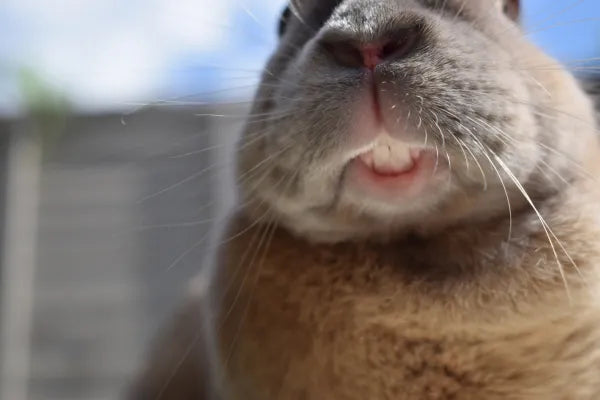
Dental disease is the most common serious health problem we see in pet rabbits and guinea pigs, and it is also the one owners catch latest. Not through neglect - it is genuinely hard to spot. The teeth causing the trouble are usually the ones right at the back that nobody can see without a vet, a light and a speculum.
What you can see are the knock-on effects. Learn those and you will catch it weeks or months earlier, which is the difference between a straightforward burr under anaesthetic and a chronic problem with abscesses.
What overgrown teeth actually means
Rabbit and guinea pig teeth grow continuously and are worn down by grinding fibrous food. When the wear stops matching the growth, the teeth become misaligned - malocclusion.
There are two versions, and they behave very differently.
Incisor malocclusion is the front teeth. This one you can see. The upper and lower incisors stop meeting cleanly and start to splay, curl or grow past each other. In advanced cases they curl out of the mouth entirely.
Cheek tooth malocclusion is the back teeth, and it is far more common and far more dangerous. The teeth grow unevenly into sharp points called spurs, which cut into the tongue and the inside of the cheek. It is painful, and completely invisible from outside.
Some animals are predisposed regardless of diet. Dwarf and lop rabbits have shortened, rounded skulls that make clean tooth alignment harder, so they need closer monitoring. Past that, the biggest driver is a diet too low in long-stem hay.
The signs, and how urgently to act
| What you notice | What it can mean | How urgently to act |
|---|---|---|
| Not eating at all | Gut stasis risk | Same day, including after hours |
| Fewer or smaller droppings | Reduced intake, and gut slowdown | Within 24 hours |
| Loud, deliberate teeth grinding while resting | Pain behaviour | Within 24 hours |
| A firm lump on the jaw or cheek | Possible tooth root abscess | Within 24 hours |
| Dropping food from the mouth while chewing | Spurs on the cheek teeth making chewing painful | Within a week |
| Eating pellets and treats but leaving hay | Hay needs more grinding, so it hurts more | Within a week |
| Wet chin, damp chest or a matted dewlap | Drooling, which almost always means mouth pain | Within a week |
| Steady weight loss | Eating less than it looks like they are | Within a week |
| Watery eye or discharge, usually one side | In rabbits, a tooth root pressing on the tear duct | Within a week |
| Stopped grooming, scruffy or matted coat | Cannot reach to groom comfortably | Within a week |
One clarification on that grinding row: guinea pigs also make a soft, quiet bruxing sound when they are relaxed and being handled, and that one is contentment. It is the loud, deliberate grinding, usually while hunched and still, that you are listening for.
The top row is the one to remember. A rabbit or guinea pig that has eaten nothing for twelve hours is not being fussy. Their digestive system needs constant throughput, and a gut that stalls becomes life threatening quickly. It is one of the few situations where an after-hours vet visit is clearly the right call.
The weekly check that catches it early
Five minutes, once a week. You are building a baseline so you notice change.
Weigh them. Kitchen scales and a small container work fine. Write the number in your phone. Weight loss is the earliest and most reliable signal you will get, and it shows up long before anything is visible.
Feel the chin and chest. Should be dry. Damp fur under the jaw is a drooling sign.
Look at the front teeth. Gently part the lips. In rabbits, the uppers should sit just in front of the lowers and meet cleanly. Guinea pigs look different, and this catches people out - their lower incisors are naturally much longer than the uppers, so length on its own is not a problem. What you are watching for in both species is change: teeth splaying sideways, curling, angling off to one side, or growing past each other when they did not last month.
Look in the litter tray. Plenty of round, pea-sized droppings is what you want. Fewer, smaller, or strung together with fur means intake has dropped.
Watch them eat. Not just that they eat, but how. Chewing on one side, tipping the head, picking food up and dropping it, or going back to the same mouthful repeatedly is worth noting.
If you are unsure what normal looks like, ask us to show you in store. It is far easier to demonstrate on a real animal than to describe.
Never trim the teeth at home
We need to be blunt about this, because there are videos online suggesting otherwise.
Do not clip a rabbit or guinea pig's teeth with nail clippers, side cutters or anything else. The teeth shatter rather than cut cleanly. Fractures run up into the pulp, cause severe pain, and open the door to a root abscess far worse than what you were trying to fix.
Vets use a dental burr under anaesthetic, which shapes the tooth without fracturing it, and it lets them see and treat the cheek teeth at the same time - which is where the real problem usually is. Animals with malocclusion often need this repeated every few months for life. Not ideal, but very manageable once you are in a routine. Not every practice sees a lot of rabbits and guinea pigs, and it does make a difference, so ask us if you need pointing towards one that does.
Prevention is mostly one thing
Unlimited long-stem grass hay, every day, for life. Oaten, wheaten, meadow or timothy. It should make up the overwhelming bulk of what they eat, with fresh greens daily and only a small measure of pellets. Lucerne is not a substitute - it is a legume, too high in calcium and protein for adults, so treat it as an occasional extra rather than the daily hay.
Skip muesli-style mixes too. The colourful ones with flaked corn, peas and seeds let the animal pick out the sweet bits and leave the fibre behind, which is precisely the wrong outcome for teeth. A plain uniform pellet, in a small measured amount, avoids the problem.
One guinea pig specific note: they cannot make their own vitamin C, and a deficiency causes reluctance to eat and steady weight loss that looks a lot like a dental problem. Fresh capsicum and leafy greens daily, plus a supplement, covers it.
Beyond that: safe things to chew, like untreated willow, apple sticks and wooden gnaw toys. Regular weighing. And for lops and dwarf rabbits, a vet dental check built into their annual visit rather than waiting for symptoms.
Dental disease in these species is largely preventable and highly treatable when caught early. The pets who do badly are almost always the ones whose owners did not know what to watch for. Now you do - and if you want a hand setting up a hay-first diet, come and see us.guine


