


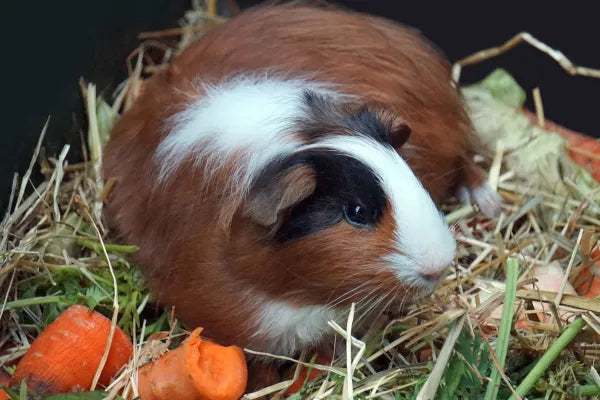
Ask most new rabbit or guinea pig owners what hay is for and they will say fibre, or bedding, or something to nibble between proper meals. All of which sells it short. Hay is the single most important dental tool your small pet has, and the reason vets get so insistent about it has almost nothing to do with digestion.
Here is what is actually happening in your rabbit's mouth, and why the ratio of hay to pellets in the bowl matters more than the brand on the bag.
Their teeth never stop growing
Rabbits and guinea pigs have what are called elodont teeth. Every tooth in their head grows continuously for their entire life - the front incisors you can see, and the cheek teeth right at the back that you cannot. An incisor can put on a couple of millimetres a week.
That sounds alarming until you see how they are meant to manage it. Wild rabbits and cavies spend the better part of the day working through tough, fibrous grass, and that grinding wears the teeth down at roughly the same rate they grow. The system is beautifully self-regulating, right up until we change the food.
Pellets and hay are chewed completely differently
This is the bit that surprises people. It is not just how much they chew, it is how.
Long-stem hay has to be ground with a wide side-to-side sweep of the lower jaw. That lateral motion is what wears the cheek teeth down flat and even. Pellets and soft treats need a much smaller vertical crush - up and down, less sideways, over in seconds.
So a guinea pig on a pellet-heavy diet is still eating, still gaining weight, still looks perfectly happy, and is grinding almost none of its back teeth. Over months the cheek teeth grow unevenly and form sharp points called spurs, which cut into the tongue and cheek. By the time it shows up as a pet dropping food, there is usually a fair bit of damage in there.
You cannot see any of this at home. There is no way to view a rabbit's cheek teeth without a speculum and a vet holding it.
What the bowl should actually look like
Unlimited grass hay, all day, every day, topped up fresh. It should be around 70 to 80 per cent of everything they eat. Everything else is a supporting act.
| Species and stage | Grass hay | Fresh greens | Pellets | Notes |
|---|---|---|---|---|
| Rabbit, adult (over 12 months) | Unlimited, at least their own body size in volume daily | About 1 cup per kg body weight | Roughly 1 tablespoon per kg body weight | Pellets are a supplement, not a meal |
| Guinea pig, adult (over 6 months) | Unlimited | 1 cup daily, including a vitamin C source | Roughly 1 eighth of a cup daily | Cannot make their own vitamin C, so greens are non-negotiable |
| Growing rabbit (under 12 months) | Unlimited, can include lucerne | Introduce slowly | Slightly more generous, on a junior formula | Growing animals need the extra protein and calcium |
| Growing guinea pig (under 6 months) | Unlimited, part lucerne part grass hay | Daily, with vitamin C from the start | Slightly more generous, on a junior formula | Guinea pigs mature faster than rabbits, so they move to adult food earlier |
Those pellet amounts are a starting point rather than a prescription. Body condition varies, and if your pet is over or underweight your vet will want to adjust it. Pregnant and nursing mothers, and any animal recovering from illness, also sit in the richer category regardless of age.
Which hay, and does it matter?
Grass hays are what you want as the daily staple - oaten, wheaten, meadow or timothy. They are high in fibre, low in protein, and coarse enough to demand real chewing.
Lucerne, also sold as alfalfa, is a legume rather than a grass. It is much higher in protein and calcium, which makes it excellent for babies, pregnant or nursing mothers, and underweight animals. For a healthy adult it is too rich, and the calcium load raises the risk of bladder sludge and stones. Use it as an occasional treat handful rather than the bed of the diet.
Fine, soft, dusty hay is the least useful kind. If it crumbles in your hand it will not do much grinding. You want long strands your pet has to wrestle with.
Storing it properly, in an Australian summer
Hay kept in a hot shed or garage goes dusty and can grow mould, and mouldy hay is worse than no hay. Keep it somewhere dry and airy, out of direct sun. Check it smells sweet rather than musty before every refill, and through the humid months buy smaller amounts more often rather than stockpiling a bale you will still be working through in March.
Make them work for it
The more time spent chewing, the better the dental outcome, so anything that slows the process down helps.
Stuff hay into a cardboard tube with the ends folded over. Fill a hay rack rather than dumping a pile. Hide a small amount inside a paper bag or a willow ball. Scatter a handful through the enclosure so they forage for it rather than sitting at a bowl. A rabbit that spends three hours a day picking through hay is doing more for its teeth than one that eats the same volume in forty minutes.
What if yours already ignores hay?
Common, and fixable, but do it gradually rather than overnight. Cut the pellet ration back slowly over two to three weeks so hay becomes the interesting option rather than the leftover. Offer two or three different grass hays side by side, because preference is real and a pet that refuses oaten will often take to timothy or meadow. Put hay where they already spend time, including next to the litter tray, since they like to eat and toilet at once. And keep it fresh - a pile that has been sitting for two days is not appealing.
If none of that shifts it within a week or so, treat the refusal as a symptom rather than fussiness and get the mouth checked.
When a hay strike is an emergency
Rabbits and guinea pigs that stop eating are in trouble quickly. Their digestive system relies on constant throughput, and a gut that stalls becomes life threatening within hours.
So if your rabbit or guinea pig walks away from hay it has always eaten, do not wait to see if the appetite picks up tomorrow. Twelve hours with nothing eaten is a same-day vet visit, after hours if it comes to that. Sudden hay refusal often means the mouth hurts.
The short version
Hay is not the boring bit of the diet you get through so you can hand over the good stuff. It is the reason your rabbit's teeth stay the right length. Get the ratio right and you have prevented the single most common health problem these pets have.
If you are not sure whether your hay is doing the job, bring a handful in and show us. We will tell you honestly, and we would rather have that conversation now than after a dental.


