


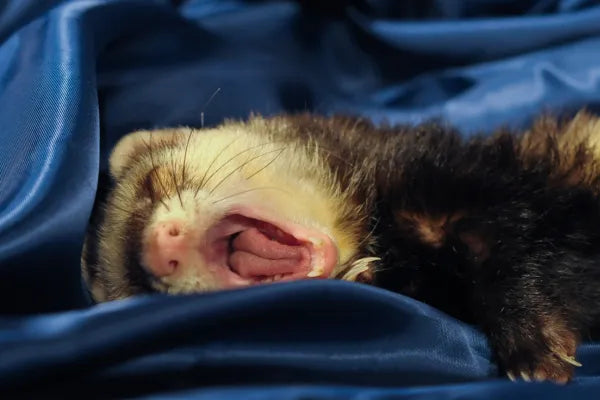
Every ferret owner knows the musk. It is warm, sweet, slightly earthy, and it clings to bedding, hammocks and the inside of your jumper. That smell is normal and permanent.
What is not normal is the smell that hits you when your ferret yawns in your face. If the odour is coming specifically from the mouth rather than the whole animal, that is a different problem with a different cause, and it is worth taking seriously.
The musk is normal. The mouth is not.
A ferret's signature smell comes from sebaceous glands in the skin, spread across the entire body. It gets stronger in unspeyed and unneutered ferrets and shifts with the seasons. Unlike in the US, descenting is not routinely performed in Australia, so the musk stays put, and that is fine. Bathing more often actually makes it worse, because the skin compensates by producing more oil.
Oral odour behaves differently. It is localised, sharper, and often described as rotten, metallic or sour rather than musky. You notice it when your ferret is close to your face, not when you walk into the room.
Why ferrets get dental disease when the rest of the small animal category does not
Ferrets are obligate carnivores, which puts them completely at odds with the rabbits and guinea pigs sitting next to them in the small animal department. Rabbits and guinea pigs have continuously growing teeth that wear down against hay all day. Ferrets have 34 permanent teeth that stop growing and never get replaced, so any damage is permanent.
Three things go wrong most often:
- Tartar buildup. Most Australian ferrets eat dry kibble or a mixed diet. Kibble does very little scraping, so plaque mineralises along the gumline, especially on the big premolars and molars at the back.
- Fractured canine tips. Ferrets chew cage bars. Those long canines are thin at the tip and snap easily. A broken canine can expose the pulp, which is painful and can abscess at the root.
- Gingivitis and gum recession. Older ferrets often show a red line along the gumline before anything else is visible.
What the smell is probably telling you
| What you're seeing | Likely cause | What to do |
|---|---|---|
| Mild odour, brown-yellow crust on back teeth | Tartar and early gingivitis | Book a dental check, start home care |
| Foul odour, red or bleeding gums | Established periodontal disease | Vet appointment, likely needs a scale under anaesthetic |
| Odour plus a visibly chipped or discoloured canine | Fractured tooth, possible root abscess | Vet appointment soon, this is painful |
| Odour plus drooling, pawing at the mouth, wobbliness | Possible insulinoma or nausea, not a dental issue | Vet the same day |
| Odour plus vomiting, black tarry stool, weight loss | Possible gastric ulceration | Vet appointment promptly |
When bad breath is not a dental problem at all
This is the part that catches owners out. In ferrets, mouth odour is a genuine early warning sign for several conditions that have nothing to do with teeth.
Insulinoma is common in ferrets from about three years of age and causes nausea, excessive salivation and pawing at the mouth. Owners frequently read that as a dental problem. If your ferret is also glassy-eyed, wobbly in the back end, or sleeping much harder than usual, treat it as urgent.
Gastric ulceration, often linked to Helicobacter mustelae, produces a sour odour along with grinding teeth, poor appetite and dark tarry droppings.
Kidney disease in older ferrets can produce a distinctly ammonia-like breath.
None of these are fixable at home. If the smell arrives alongside any change in appetite, energy or droppings, skip the toothbrush and book the vet.
What you can actually do at home
Start home care early, ideally while your ferret is young and still negotiable.
Brushing works, but only with a pet enzymatic toothpaste. Never use human toothpaste. Many contain xylitol, which appears on Australian labels as xylitol, birch sugar or E967, and it is dangerous to pets. A soft finger brush is easier than a standard toothbrush in a mouth that small. Build up over a week or two: paste on your finger first, then a quick touch of the outer teeth, then longer sessions.
Supervised raw meaty items help mechanically. Chicken necks and wing tips give the carnassials something to actually shear through. Introduce them gradually, always raw, never cooked, and always with you in the room.
On diet, look for a high-protein, high-fat ferret or kitten food with named meat as the first several ingredients and minimal grain or plant filler. Keep sugary treats out entirely. Ferrets cannot process carbohydrates well, and sweet pastes and dried fruit are a poor idea for both their teeth and their pancreas.
Professional cleaning, and one thing to avoid
A proper scale and polish requires a general anaesthetic. Anaesthesia-free dental cleaning is not an adequate substitute for any pet, and for a ferret it is close to meaningless: the scaling that matters happens below the gumline, which cannot be reached or assessed in a conscious animal. Scraping visible tartar off the surface makes the teeth look better while leaving the actual disease untouched.
Anaesthesia in ferrets is routine for vets who see them regularly, but the protocol differs from dogs and cats. Ferrets must not be fasted overnight, because their gut transit is fast and their hypoglycaemia risk is real, particularly if insulinoma is in the picture. Your vet will give you a much shorter fasting window.
Two Australian practicalities worth knowing. First, not every clinic sees ferrets, so ring ahead and ask for a vet with exotics experience rather than turning up. Second, most Australian pet insurance policies cover dogs and cats only, and the ones that do cover ferrets typically exclude routine dental work. Assume you are paying out of pocket and ask for a written quote before the day.
The short version
Musky ferret is normal. Smelly ferret mouth is not. Check the back teeth and gumline, and if the odour comes with drooling, weight loss or wobbliness, treat it as a vet visit rather than a dental one.
Our small animal team is in store seven days if you want to talk through home care or have someone show you how to handle a wriggly ferret for tooth brushing.


