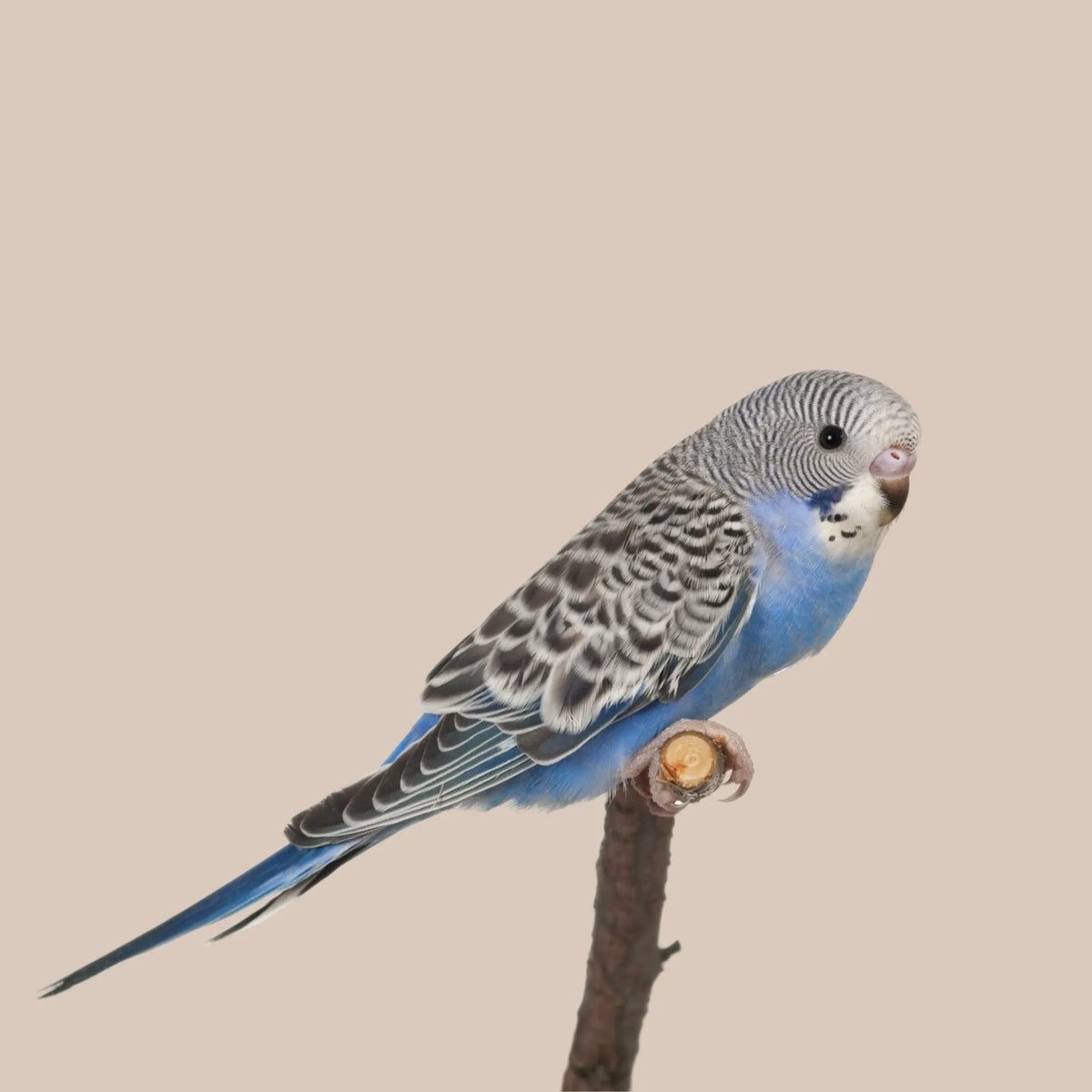
Care Guide

Budgerigar

Melopsittacus undulatus
Budgie · Common Parakeet · Shell Parakeet

Budgerigar Care Guide
Lifespan
7-10+ years
Adult Size
18-20cm; 25-35g
Care Level
Low
Diet

Quality budgie crumbles or pellets as the dietary foundation, with a budgie seed mix and daily small portions of fresh fruit and vegetables

Enclosure

Small-gauge wire cage (minimum 50cm W × 40cm D × 65cm H) or aviary, with multiple perches, toys and foraging opportunities

Temperament

Alert, curious, social and often surprisingly interactive. Hand-raised budgies are gentle and tolerant of handling

Where they come from

Natural History & Origin

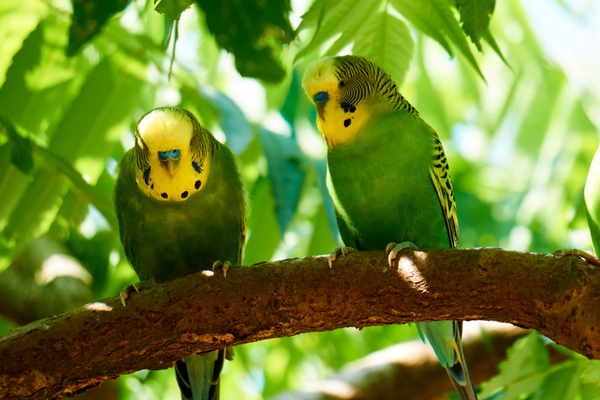
The Budgerigar is endemic to Australia and is one of the most successful and widespread of all Australian parrots. In the wild, they are found across most of the arid and semi-arid interior of the continent — from the inland regions of Western Australia, South Australia, Queensland, New South Wales and the Northern Territory. They inhabit open grasslands, scrublands, lightly wooded plains and farmland, where they form large, nomadic flocks that follow rainfall and the resulting grass seed crops.

In the wild, budgies are highly nomadic and social, with flocks sometimes numbering in the thousands. They nest in tree hollows, often in loose colonies, after rainfall events trigger breeding. They are the second most popular pet bird in the world after the domestic canary and have been kept in captivity for well over 150 years.

As a native Australian bird, the Budgerigar requires a fauna keeper licence in most Australian states. However, in some states and territories — including NSW, Queensland and Victoria — the Budgerigar is listed as an exempt species that can be kept and traded freely without a licence. Confirm current requirements with your state wildlife authority before purchasing.

Get it right early

Tips for First-Time Owners

  1. 1 A pellet or crumble base diet combined with seed and fresh food is far superior to seed alone — budgies on seed-only diets consistently live shorter, less healthy lives than those on a varied, nutritionally complete diet.
  2. 2 Handle daily from a young age to maintain tameness — a budgie that is not handled regularly will quickly become skittish.
  3. 3 Never place the cage in the kitchen — non-stick cookware and cooking fumes produce PTFE gases that are immediately lethal to birds.
  4. 4 Millet spray is the most universally accepted training reward for budgies and is invaluable for building trust — use it to encourage step-up and hand-taming.
  5. 5 In NSW, no keeper licence is required for a Budgerigar — they are one of 41 exempt native species. Requirements vary in other states — confirm with your state wildlife authority and always source from a reputable, licensed captive breeder.
Setting up the habitat

Enclosure & Husbandry

Budgerigars need enough space to spread their wings and move freely between perches without risk of injury. For a single bird, a minimum cage size of 50cm W × 40cm D × 65cm H is recommended; for a pair, 60 cm W or larger is preferable. Cages that are wider than they are tall are particularly good as budgies fly horizontally.

Open-top cages with perching areas are ideal for hand-raised birds as they allow more freedom and daily interaction with the family. At night, cover the cage partially with a breathable cover or cage cover to prevent draughts and reduce visual stress.

Provide three to four perches of varying diameter and texture — natural timber branches such as eucalyptus, grevillea, bottlebrush and lilly pilly are excellent choices as they allow natural beak exercise and provide foraging interest. Avoid smooth dowel perches as the sole option, as uniform diameter perches can cause foot problems over time. Include a cuttlebone, an iodine bell, food and water dishes, a bath or spray for regular bathing, and a selection of toys.

For pairs or small groups, an aviary of at least 1.8 m L × 0.9 m W × 1.8 m H allows the flight exercise that is important for long-term health. An aviary environment is considered by many experienced keepers to be the gold standard for budgerigar welfare."

What to feed

Dietary Management

Budgerigars should be fed a quality budgerigar crumble or pellet — such as a quality budgerigar crumble — as the primary dietary component, supplemented with a quality budgie seed mix containing a variety of seeds such as French white millet, hulled oats, pannicum and Japanese millet. Grit, offered in small amounts, assists with digestion.

Supplement the diet daily with small portions of fresh fruit and vegetables, including apple (seeds removed), carrot, peas, corn, broccoli, spinach and leafy greens. Fresh food should not be left for prolonged periods as spoiled produce can harbour bacteria and yeasts that cause illness. Never feed lettuce, avocado, or apple seeds.

Vitamin supplements such as a quality bird vitamin supplement can be added to drinking water two to three times per week. Calcium and iodine can be provided through cuttlebone and iodine bells, which should be available in the cage at all times. Fresh water must be available and changed daily. Worming with a broad-spectrum bird wormer should be repeated every three months.

Day-to-day interaction

Handling & Socialisation

Hand-raised budgerigars generally accept handling readily and can be tamed with patience and consistency. Begin with step-up training using gentle encouragement and a favoured treat — millet spray is highly effective. Handle daily to maintain tameness. Keep sessions short initially (five to ten minutes) and gradually extend. Always be calm and move slowly around budgies, as they startle easily.

For birds that are not hand-raised, taming requires patience: place the cage in a main living area, spend time near it daily, and gradually begin offering millet spray through the bars before progressing to hand feeding inside the cage. Never chase or corner a budgie — all handling progress must be voluntary.

Did you know

Fun Facts

A budgerigar named Puck holds the verified Guinness World Record for the largest vocabulary of any bird ever recorded — 1,728 words at the time of his death in 1994.

In the wild, budgerigar flocks can contain tens of thousands of birds and make some of the most remarkable aerial displays of any bird species — rolling, twisting waves of movement in perfect coordination.

Budgerigars can see ultraviolet light, which humans cannot. Under UV, their plumage displays complex patterns invisible to the human eye — patterns that play an important role in mate selection and flock recognition in the wild.

Keep them stimulated

Enrichment

Budgerigars benefit greatly from environmental enrichment. Foraging plays a central role — scatter seeds in different areas of the cage, offer food in foraging toys or woven treat baskets, and thread vegetables and fruits onto skewers to encourage natural searching behaviour. Natural branches of varying lengths, shapes and thicknesses provide exercise for the feet and beak. Branches with natural nuts, gum nuts and flowers from native species such as eucalyptus, grevillea and bottlebrush provide excellent foraging opportunities.

Provide a range of bird-safe toys — swings, bells, mirrors (for single birds), foraging wheels and puzzle feeders — and rotate them every couple of weeks to maintain novelty. Regular bathing — either in a shallow bird bath, a large flat dish of water, or a gentle spray — is important for feather condition and is enjoyed by most budgies. Talking and whistling interaction daily encourages speech development and strengthens the human-bird bond.

What to watch for

Common Health Issues

Psittacosis (Chlamydiosis): A bacterial lung infection transmissible to humans, often carried without obvious symptoms. Annual vet checks, good hygiene and quarantine of new birds are key preventative measures.

Psittacine Beak and Feather Disease (PBFD), often called 'French moult' in Budgies: A serious viral disease causing feather and beak abnormalities — source birds from reputable, tested breeders.

Scaly face mite (Cnemidocoptes pilae): Causes crusty, honeycomb-textured growths on the cere (nose), beak and legs — treated effectively by a vet if caught early.

Respiratory infections: Often linked to vitamin A deficiency; a varied diet with pellets reduces risk.

Polyomavirus: A virus particularly affecting chicks and young birds; source from reputable breeders.

Egg binding: Can occur in breeding females — calcium supplementation during breeding reduces risk.

Tumours: Budgerigars have a higher incidence of benign and malignant tumours than most pet bird species; annual vet checks support early detection.

Everything you need

Essentials Shopping List

Setup checklist

  • Small-gauge wire cage — minimum 50 × 40 × 65cm; wider than tall preferred
  • Open-top play perch or cage top gym
  • Multiple natural timber perches of varying diameter (eucalyptus, bottlebrush, grevillea)
  • Food and water dishes (minimum two sets)
  • Quality budgerigar crumbles or pellets
  • Quality budgie seed mix
  • Bird grit (small amounts)
  • Cuttlebone
  • Iodine bell
  • Vitamin supplement (a quality bird vitamin supplement)
  • Broad-spectrum bird wormer (quarterly)
  • Millet spray (essential taming and training tool)
  • Foraging toys and treat baskets
  • Swings, bells and rotating toy selection
  • Bird bath or spray bottle for bathing
  • Breathable cage cover
  • Avian-safe cage disinfectant
  • Annual avian vet check (ongoing)
FAQ

Commonly Asked Questions

  • Do budgies talk?

    Many do, particularly males when socialised from a young age. Budgerigars are the most accomplished talkers among small parrots, with some individuals developing vocabularies of hundreds of words.

  • Should I get one budgie or two?

    Two budgies will keep each other company and are recommended if the keeper is away for long periods. However, a bonded pair will generally be less interested in human interaction. A single, well-socialised budgie that receives daily handling and attention often develops a closer relationship with its owner.

  • How do I know if my budgie is male or female?

    In adult budgies, the cere (the fleshy area above the beak) is typically blue in males and brown or pink in females. In young birds and some mutations, cere colour can be less reliable — DNA sexing is the definitive method.

  • Are budgies suitable for children?

    Yes — they are among the best birds for children when handled regularly and gently. Supervision is important to ensure calm, respectful interaction.

  • Do I need a licence to keep a budgie in Australia?

    In NSW, budgies are one of 41 native species exempt from keeper licence requirements — no licence is needed. Requirements vary in other states — confirm with your state wildlife authority before purchasing.

Need help?

Our specialists are in-store every day to help with setup, licensing and feeding.

Visit Kellyville Pets →