


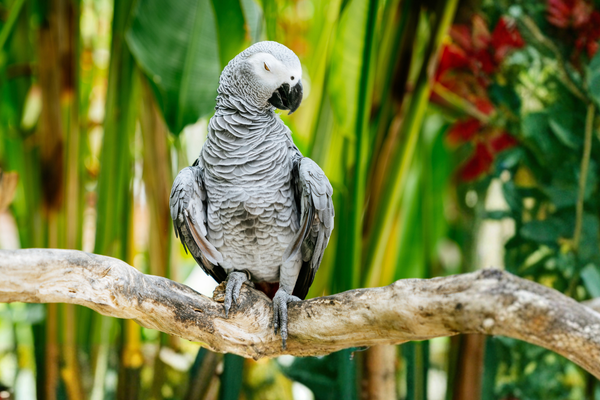
Dr. Irene Pepperberg's African Grey 'Alex' demonstrated the ability to identify objects, colours, shapes and numbers, understand the concept of 'zero', and ask questions — including once famously asking 'What colour am I?' when viewing himself in a mirror.
African Grey Parrot
Psittacus erithacus

40-60+ years

30-40cm; 400-650g

High


Where they come from
Natural History & Origin


Get it right early
Tips for First-Time Owners
- 1 African Greys are not beginner birds — they require an extraordinary daily investment of time, interaction and enrichment. Be completely honest with yourself about whether you can commit to two to three hours of active engagement every single day before acquiring one.
- 2 A pellet-based diet is the single most important dietary decision — seed-only diets cause nutritional deficiencies that shorten lifespan significantly. Transition new birds to pellets as a dietary foundation.
- 3 Calcium supplementation is critically important for this species — always provide cuttlebone and include calcium-rich foods such as leafy greens, almonds and dairy (in small amounts) in the diet.
- 4 Feather plucking is far easier to prevent than to cure — enrich the environment relentlessly, maintain consistent daily interaction, and consult an avian vet at the very first sign of feather damage.
- 5 Confirm licensing requirements in your state before purchasing — African Greys are exotic birds in Australia and requirements for keeping them vary between states.
Setting up the habitat
Enclosure & Husbandry
What to feed
Dietary Management
Day-to-day interaction
Handling & Socialisation
Find your next best friend
Browse all Handraised Birds
Our Available Handraised Birds
Did you know
Fun Facts
African Greys are believed to show emotional and cognitive abilities in certain domains, comparable to that of a young child — approximately four to five years of age — and can live for over 60 years, creating a relationship of unusual depth and complexity.
Wild African Grey flocks can number in the thousands and are known to use specific 'dialects' — regional vocal variations used to identify members of their own flock — a level of acoustic social complexity previously thought to be unique to humans and cetaceans.
Keep them stimulated
Enrichment
What to watch for
Common Health Issues
Everything you need
Essentials Shopping List
Setup checklist
- Large powder-coated or stainless steel cage — minimum 100 × 75 × 150 cm
- Play top or dedicated gym/play stand
- Three to four natural timber perches of varying diameter (eucalyptus, bottlebrush)
- Stainless steel food and water dishes (minimum two sets for daily rotation)
- High-quality large parrot pellets (a quality natural parrot pellet, a quality parrot pellet or equivalent)
- Varied fresh fruit and vegetables (daily)
- Cuttlebone
- Vitamin supplement (a quality bird vitamin supplement)
- Broad-spectrum bird wormer (quarterly)
- Minimum six to eight rotating toys: foraging toys, puzzle feeders, chew toys, foot toys
- Foraging skewers or kabob holders
- Cage cover (breathable fabric)
- Avian-safe cage disinfectant
- Insect/parasite control
- Bird-safe cage liner / newspaper
- Annual avian vet check (ongoing)
- Exotic bird permit / licence (state-specific — confirm before purchasing)
READY TO SET UP
Browse all
Shop the Essentials

Avigrain Wild Bird Mix 20kg
$28.49
View →

Avigrain Small Parrot Mix 20kg
$36.49
View →

Avigrain Budgie Blue 20kg
$52.99
View →

Budgie Mix
from$15.99
View →

Forage Gourmet Eclectus Food
from$32.99
View →

Forage Pinecone Bird Treat
from$21.49
View →

Save 10%
Vetafarm Parrot Essentials

Forage Gourmet Conure & Quaker Food
from$17.99
View →
FAQ
Commonly Asked Questions
-
Are African Greys the most intelligent parrot?
-
Do African Greys talk?
-
Can I leave an African Grey alone while I work?
-
Do African Greys need a licence in Australia?
-
How long do African Greys live?
Learn more
See more care guides Read about other species
No articles match that search. Try a different word.


Need help?Our specialists are in-store every day to help with set up, licensing and feeding.
Visit Kellyville Pets