


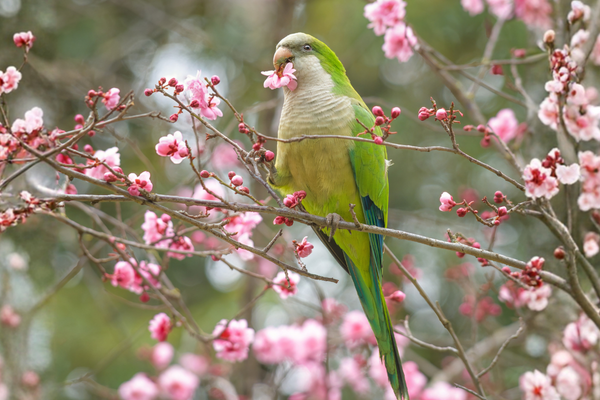
Quaker Parrots are the only parrot species known to build large, permanent, communal stick nests — most parrots nest in tree hollows. Colonial Quaker nests in South America can become enormous multi-chambered structures used by dozens of pairs simultaneously, and have even been documented on electrical pylons and transmission towers.
Quaker Parrot
Myiopsitta monachus

15-20+ years

28-31cm; 90-120g

Low to Medium


Where they come from
Natural History & Origin


Get it right early
Tips for First-Time Owners
- 1 Secure housing is not optional for Quaker Parrots in Australia — this is both a legal requirement in some states and a genuine biosecurity responsibility. Ensure your cage and any aviary have bird-proof, Quaker-proof latches and no gaps through which the bird could escape.
- 2 Allow occasional access to safe nesting materials — paper strips or palm fronds — as nest-building is natural to this species, but remove them if hormonal or aggressive behaviour increases.
- 3 A pellet-based diet is the foundation of long-term health — Quakers on predominantly seed diets are more prone to nutritional deficiency and fatty liver disease.
- 4 Handle daily and involve all household members in regular interaction — Quakers that bond to one person can become territorial and aggressive toward everyone else.
- 5 Confirm current requirements in your state before purchasing — regulations regarding secure housing vary between states and can change.
Setting up the habitat
Enclosure & Husbandry
What to feed
Dietary Management
Day-to-day interaction
Handling & Socialisation
Find your next best friend
Browse all Handraised Birds
Our Available Handraised Birds
Did you know
Fun Facts
They are among the most accomplished talkers in the small-parrot category — many Quakers develop large, clear vocabularies of dozens of words and phrases, and some individuals are remarkably consistent in contextually appropriate use of language.
Despite being native to warm-temperate South America, wild Quaker Parrots have established flourishing feral colonies in climates as cold as Chicago, New York and London — a testament to their remarkable adaptability and the insulating warmth of their large colonial stick nests.
Keep them stimulated
Enrichment
What to watch for
Common Health Issues
Everything you need
Essentials Shopping List
Setup checklist
- Medium powder-coated or stainless steel cage — minimum 90 × 50 × 90 cm with Quaker-proof latches
- Multiple perches: natural timber, textured
- Stainless steel food and water dishes (minimum two sets)
- Quality medium parrot pellets
- Varied fresh fruit and vegetables (daily)
- Small-to-medium parrot seed mix (supplement only)
- Cuttlebone and iodine bell
- Vitamin supplement (a quality bird vitamin supplement)
- Broad-spectrum bird wormer (quarterly)
- Nest-building materials: paper strips, palm strips, dried grass, soft wooden sticks
- Minimum six rotating toys: chew toys, foraging toys, foot toys, swings, bells
- Foraging toys and puzzle feeders
- Play gym or play top
- Shallow bathing dish or fine-mist spray bottle
- Cage cover (breathable fabric)
- Avian-safe cage disinfectant
- Annual avian vet check (ongoing)
READY TO SET UP
Browse all
Shop the Essentials

Avigrain Wild Bird Mix 20kg
$28.49
View →

Avigrain Small Parrot Mix 20kg
$36.49
View →

Avigrain Budgie Blue 20kg
$52.99
View →

Budgie Mix
from$15.99
View →

Forage Pinecone Bird Treat
from$21.49
View →

Save 10%
Vetafarm Parrot Essentials

Forage Gourmet Conure & Quaker Food
from$17.99
View →

Avigrain Budgie Green Mix 20kg
$44.99
View →
FAQ
Commonly Asked Questions
-
Are Quaker Parrots legal in all Australian states?
-
Why does my Quaker arrange and rearrange its cage materials?
-
Do Quaker Parrots talk?
-
Can Quaker Parrots be housed with other birds?
-
How do I stop my Quaker from escaping?
Learn more
See more care guides Read about other species
No articles match that search. Try a different word.


Need help?Our specialists are in-store every day to help with set up, licensing and feeding.
Visit Kellyville Pets