


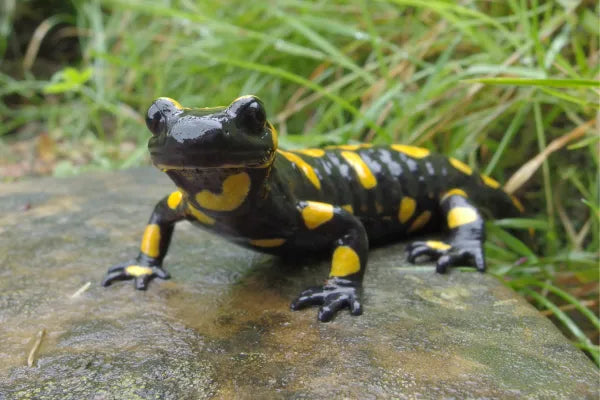
Salamanders turn up everywhere online lately, mostly in the shape of a grinning pink axolotl. Before you go looking for one, it's worth clearing up: Australia's biosecurity laws make almost every salamander species off-limits, and the one exception has its own quirks. Here's where the axolotl comes from, why it never grows legs, and what to weigh up before bringing one home.
What Is a Salamander, and Where Does the Axolotl Fit In?
Salamanders belong to the order Caudata, a group of tailed amphibians that includes newts, fire salamanders, tiger salamanders and around 700 other species worldwide. Most spend part of their life in water as gilled larvae, then transform into land-dwelling adults.
The axolotl (Ambystoma mexicanum) is a member of this group but the odd one out. It comes from a single place: Lake Xochimilco, a shrinking network of canals on the edge of Mexico City. Named after Xolotl, the Aztec god linked to fire and death, it's been studied by scientists for over a century for its extraordinary ability to regrow limbs, organs and even parts of its spinal cord. In the wild it's critically endangered, squeezed by pollution, development and introduced fish that prey on its eggs.
The Legal Reality: Why Most Salamanders Can't Be Kept Here
Australia treats exotic amphibians as a serious biosecurity risk. A new frog or salamander species could introduce disease (native frogs are already battling chytrid fungus) or establish as an invasive species if it escapes or is released. So importing fire salamanders, tiger salamanders, newts or any other true salamander is not permitted, whatever you might see for sale overseas.
The axolotl is the one carve-out. In New South Wales, it's listed as the only non-native amphibian that can legally be kept as a pet without a licence. Rules differ state to state, so check with your local environment department if you're outside NSW. Either way, it's currently the only "salamander" most Australians can legally keep.
How Metamorphosis Works (and Why Yours Won't Grow Legs)
In a typical salamander, metamorphosis switches on when thyroid hormone surges in response to cues like a drying pond, changing daylight or rising temperature. That surge reshapes the animal: gills are reabsorbed, lungs develop, and it moves from water onto land.
Axolotls carry a genetic quirk that stops this process completing. Their bodies don't respond to thyroid hormone the way other salamanders do, so they stay in their aquatic, gilled, larval form for life. Biologists call this neoteny, and it's why an axolotl looks the same at fifteen as it did as a juvenile.
Metamorphosis can technically be forced with iodine or hormone treatment, and you'll find claims about this online. Please don't try it. It's stressful, unnatural, and typically shortens their lifespan dramatically.
Ethical Considerations Before You Get One
A few things worth sitting with before you buy an axolotl:
- Buy from reputable Australian breeders and pet shops only. Never import or buy a "true" salamander species; it's illegal and risky for our ecosystems.
- This is a 10 to 15 year commitment, not an impulse buy.
- A pet axolotl doesn't help the wild population. Captive lines have been bred in labs and aquariums for over a century and are genetically distinct from the critically endangered wild animals in Lake Xochimilco. Still a fascinating species to keep, just not a conservation project.
- Never release an axolotl into a creek, dam or waterway. It's illegal, and risks native fish and frogs.
- They're not a handling pet. Delicate skin means this suits an observer rather than a cuddler.
Axolotl Care at a Glance
| Requirement | What to provide |
|---|---|
| Tank size | 150L minimum for one adult, longer rather than taller |
| Water temperature | 16-20°C; a chiller is usually essential over an Australian summer |
| Water quality | Zero ammonia and nitrite, nitrate under 20ppm, weekly partial water changes |
| Substrate | Fine sand or bare-bottomed tank; avoid gravel, which can cause impaction if swallowed |
| Diet | Earthworms, bloodworms, prawn pieces and axolotl-specific pellets, every 2-3 days for adults |
| Tank mates | None recommended; axolotls will nibble smaller fish and each other if sizes are mismatched |
| Lifespan | 10-15 years, sometimes longer |
If an Axolotl Isn't Right for You: Alternatives
If it's the amphibian side that appeals, a licensed native frog such as a Green Tree Frog offers a similar aquatic-terrarium setup under a frog keeper licence. Want something unusual to look at rather than hold? A blue tongue lizard or bearded dragon scratches that itch under a reptile keeper licence. Or if it's really the underwater world you're after, a tropical freshwater fish tank gives you that without the temperature-control demands of an axolotl.
The Bottom Line
Almost every salamander species is legally out of reach in Australia, and for good biosecurity reasons. The axolotl is the exception, but it comes with a genuinely different care routine to a typical fish tank or reptile enclosure: cool water, a long lifespan and a hands-off approach to handling. If you're weighing one up, our reptile and aquarium team can talk you through setup, legal requirements in your area and whether it's the right fit for your household.


