Care Guide6 min read

Alexandrine Parrot

Psittacula eupatria
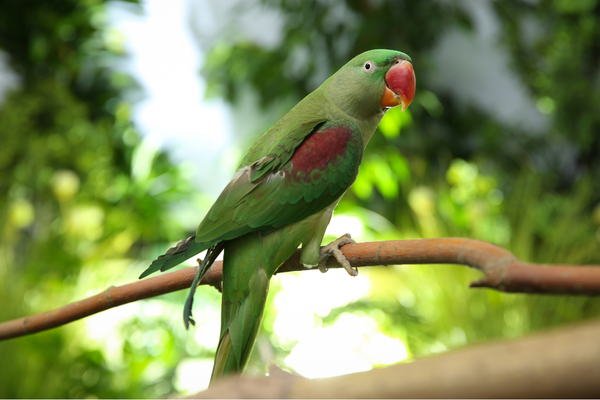
Alexandrine Parakeet · Large Indian Parakeet · Great-billed Parakeet

Alexandrine Parrot Care Guide
Lifespan
25-30+ years
Adult Size
56-62cm; 200-300g
Care Level
Medium
Diet

Quality large parrot pellets as the dietary foundation, with daily fresh fruit, vegetables and limited seed and nuts

Enclosure

Large, tall powder-coated or stainless steel cage (minimum 100cm W × 75cm D ×150 cm H) with adequate height for the long tail and a play top or gym

Temperament

Intelligent, playful and independent. Not typically lap birds — they are confident, somewhat self-sufficient parrots that enjoy human company on their own terms

Where they come from

Natural History & Origin

The Alexandrine Parrot is native to a broad swathe of South and Southeast Asia, ranging from Pakistan, India and Sri Lanka eastward to Cambodia and Vietnam. They inhabit a wide variety of environments — tropical and subtropical forests, mangroves, palm plantations, open woodland and agricultural land — showing considerable adaptability. They are gregarious and noisy in the wild, roosting communally and nesting in tree hollows, and have established feral populations in parts of Europe, the Middle East and elsewhere through escaped and released captive birds.

The species is named after Alexander the Great, who legend states introduced the birds to Europe and the Mediterranean following his Indian campaigns around 326 BCE — making the Alexandrine potentially one of the oldest documented pet parrots in human history. They are the largest of the Psittacula parakeet genus and share the distinctive long tail feathers that characterise the group. In Australia they are kept as exotic birds; a permit may be required in some states.

Get it right early

Tips for First-Time Owners

  1. 1 Cage height matters enormously for Alexandrines — ensure the cage is tall enough for the long tail to hang completely clear of the floor and cage bottom, or tail feathers will be damaged continuously.
  2. 2 Be prepared for the bluffing phase between approximately one and three years of age — this is normal, temporary and manageable with patience and consistent positive reinforcement.
  3. 3 Transition to a pellet-based diet as the dietary foundation — Alexandrines on seed-only diets develop nutritional deficiencies that are entirely preventable.
  4. 4 Provide dedicated chewing opportunities every single day — Alexandrines have powerful beaks and a fundamental need to chew; destructive behaviour directed at cage fittings, perches or household objects is almost always a sign of insufficient appropriate chewing material.
  5. 5 Annual avian vet checks are strongly recommended — establish a relationship with an avian vet early and do not wait for visible signs of illness to seek professional advice.
Setting up the habitat

Enclosure & Husbandry

Alexandrines require a tall cage to accommodate their long tail feathers — insufficient height forces the tail to drag on the cage floor, causing damage and discomfort. Minimum cage dimensions are 100cm W × 75cm D × 150cm H; larger is always better. Bar spacing of 2.5–3 cm is appropriate. Powder-coated or stainless steel construction is recommended — galvanised cages can cause zinc toxicity.

Provide multiple sturdy perches of varying diameters — Alexandrines are enthusiastic chewers and natural timber perches are preferable as they encourage natural beak conditioning. Position perches so the tail hangs freely without touching the cage bars or floor. A play top or gym area above the cage provides essential out-of-cage territory.

Cage placement should be in a main living area where the bird can see household activity and feel part of the family, but away from kitchen fumes, direct sun, cold draughts and air conditioning vents. Cover partially at night. Provide a minimum of six toys in rotation, including chew toys, puzzle feeders, foraging toys and foot toys. Alexandrines are powerful chewers and toys must be appropriately robust — softwood chew blocks, natural dried branches and commercially made wooden toys are all suitable.

What to feed

Dietary Management

Alexandrines should be fed a quality large parrot pellet (such as a South American or tropical parrot formulation) as the primary dietary component, constituting approximately 60–70% of the diet. Supplement daily with a variety of fresh fruit and vegetables — suitable options include apple, pear, mango, fig, banana, capsicum, carrot, broccoli, corn, peas, sweet potato and leafy greens. Fresh food should be removed after two to three hours to prevent bacterial contamination.

Never feed avocado, chocolate, onion, garlic, fruit pips or seeds, caffeine, alcohol or processed and salted human food. A small amount of quality parrot seed mix can be offered as a supplement but should not replace the pellet base. Nuts — almonds, walnuts and macadamias — make excellent training rewards in small quantities. Cuttlebone should be available at all times for calcium and beak conditioning. Vitamin supplements such as a quality bird vitamin supplement can be added to drinking water two to three times per week. Fresh water must be changed daily.

Day-to-day interaction

Handling & Socialisation

Hand-raised Alexandrines generally develop strong bonds with their owners and can be affectionate, but rarely demand constant physical contact. They are highly capable mimics and often develop clear, contextually appropriate speech. They can be territorial around their cage and possessive of preferred perches.

Step-up training can be commenced using positive reinforcement and consistency, after they have been given a few days to acclimatise to their new setting. Alexandrines respond well to patient, calm training but poorly to force or intimidation. Allow the bird to come to you — never chase or corner. Short, frequent training sessions of five to ten minutes are more effective than long, infrequent ones.

During the bluffing phase, maintain consistent daily handling even if the bird is nippy — retreat from the interaction rather than retaliating, and return calmly. Most Alexandrines pass through this phase and return to being manageable and sociable. Out-of-cage time of one to two hours daily is important for physical and mental wellbeing. Never clip wings without veterinary guidance and informed consideration of the individual bird's needs.

Did you know

Fun Facts

The Alexandrine Parrot is named after Alexander the Great, who transported large numbers of these birds back to Greece and the Mediterranean following his campaigns in India around 326 BCE — making them one of the earliest documented exotic pet birds in the Western world, depicted in ancient mosaics and described by Aristotle.

Alexandrines are the largest of the Psittacula genus and one of the largest parakeet species in the world — their long tail feathers can account for up to half their total length.

Wild Alexandrines are known to cause significant agricultural damage to crops including mangoes, guavas and grain in parts of their native Asian range — their powerful beaks allow them to access fruit and crops that smaller parrots cannot.

Keep them stimulated

Enrichment

Alexandrines are active, intelligent birds that need daily physical and mental engagement. Provide a varied selection of toys in rotation — chew toys, puzzle feeders, foraging toys, swings and bells — and replace or rotate weekly to maintain novelty. Foraging enrichment is highly effective: wrap food items in paper, hide treats in foraging boxes, or thread food onto skewers to encourage problem-solving behaviour.

Trick training using positive reinforcement is one of the most effective forms of enrichment and strengthens the human-bird relationship significantly. Teach step-up, wave, turn around, and target training as foundational behaviours. Provide regular supervised out-of-cage time with access to a separate play gym and safe household environment. Chewing is a fundamental behavioural need — always have fresh softwood chews, dried natural branches and appropriately sized commercial chew toys available.

What to watch for

Common Health Issues

Psittacosis (Chlamydiosis): A bacterial lung infection transmissible to humans, often carried without obvious symptoms. Annual vet checks, good hygiene and quarantine of new birds are key preventative measures.

Polyomavirus: A viral disease particularly affecting young birds and causing serious illness or sudden death — source birds from reputable, tested breeders.

Respiratory infections: Often linked to vitamin A deficiency; a pellet-based diet significantly reduces risk.

Feather Destructive Behaviour: Less common in Alexandrines than in highly strung species, but can develop with prolonged boredom or insufficient social interaction.

Proventricular Dilatation Disease (PDD): A neurological and digestive viral disease affecting psittacines — no cure; source from healthy, reputable stock.

Obesity: Common when diet is seed-heavy; ensure pellets form the dietary base and limit fatty seeds and nuts.

Bacterial infections can occur when hygiene is inadequate or the bird is immunocompromised.

Everything you need

Essentials Shopping List

Setup checklist

  • Large tall powder-coated or stainless steel cage — minimum 100 × 75 × 150 cm
  • Play top or separate gym/play stand
  • Multiple sturdy natural timber perches of varying diameter
  • Stainless steel food and water dishes (minimum two sets)
  • High-quality large parrot pellets
  • Varied fresh fruit and vegetables (daily)
  • Cuttlebone and iodine bell
  • Vitamin supplement (a quality bird vitamin supplement)
  • Broad-spectrum bird wormer (quarterly)
  • Minimum six rotating toys: chew toys, puzzle feeders, foraging toys, foot toys, swings
  • Softwood chew blocks and dried natural branches
  • Foraging skewers or kabob holders
  • Cage cover (breathable fabric)
  • Avian-safe cage disinfectant
  • Annual avian vet check (ongoing)
FAQ

Commonly Asked Questions

  • Do Alexandrine Parrots talk?

    Many do, and they can develop clear, contextually used speech. Individuals vary — some are highly vocal and chatty, others less so. Consistent talking interaction from an early age encourages speech development.

  • How noisy are Alexandrines?

    They can be loud, particularly at dawn and dusk. They are not the noisiest parrot species, but their calls are deep and carry well. This is worth considering in apartment or close-neighbour living situations.

  • What is the bluffing phase?

    A hormonal developmental period, typically occurring between one and three years of age, during which Alexandrines may become nippy, moody or defensive. It is entirely normal, temporary and manageable with consistent handling and positive reinforcement.

  • Can I keep an Alexandrine with other birds?

    Alexandrines can be kept with others of their own species, though introductions should be monitored. Their powerful beak makes them a risk to smaller species — do not house with birds significantly smaller or weaker.

  • Do I need a licence for an Alexandrine in Australia?

    Alexandrines are exotic (non-native) birds and no special keeper licence is required in most Australian states. A general biosecurity obligation applies — birds must be kept securely to prevent escape.

Need help?Our specialists are in-store every day to help with set up, licensing and feeding.

Visit Kellyville Pets