Care Guide6 min read

King Parrot

Alisterus scapularis

Australian King Parrot · Eastern King Parrot

King Parrot Care Guide
Lifespan
20-25 years
Adult Size
43cm; 190-210g
Care Level
Low to Medium
Diet

Quality medium parrot pellets, small parrot seed mix, and daily fresh fruit and vegetables — low in fat, high in variety

Enclosure

Medium-to-large powder-coated or wire cage (minimum 100cm W × 75cm D × 150cm H) or aviary, with natural timber perches, multiple toys and a play top

Temperament

Gentle, somewhat reserved and dignified — they are quieter and more observational than other parrots and tend to engage on their own terms

Where they come from

Natural History & Origin

The Australian King Parrot is native to the eastern seaboard of Australia, from the Cooktown region of north Queensland southward through New South Wales and Victoria to the South Australian border. They inhabit humid and wet sclerophyll forests, rainforest edges, and heavily timbered gullies — they are closely associated with tall, dense eucalypt forest with a rich understorey. They are commonly encountered in national parks and suburban gardens with mature tree cover along the Great Dividing Range.

King Parrots are one of Australia's most visually stunning native birds and have a devoted following among aviculturalists. Hand-raised birds can develop into gentle, personable companions — though they tend to be somewhat more reserved than species such as the Galah or Cockatiel. They are predominantly seed and fruit eaters in the wild, and their diet in captivity requires careful management to prevent obesity.

As a native Australian bird, the King Parrot requires a fauna keeper licence in all states and territories. Animals must be sourced from licensed, captive-bred stock — wild King Parrots cannot be legally kept as pets.

Get it right early

Tips for First-Time Owners

  1. 1 Male King Parrots do not develop full adult red colouration until approximately two years of age — if colour is important to you, DNA sex testing before purchase or purchasing an adult bird is recommended.
  2. 2 An outdoor aviary is strongly recommended over an indoor cage alone — King Parrots are active birds that benefit greatly from flight exercise, natural sunlight and a more spacious, naturalistic environment.
  3. 3 Supplement pellets with daily fresh food and native branches — variety is key to long-term nutrition and environmental interest.
  4. 4 King Parrots tend to be more reserved than some other parrot species — respect their pace of socialisation and do not rush handling progress.
  5. 5 A fauna keeper licence is required in all states and territories — obtain yours before purchasing and source from a licensed captive breeder.
Setting up the habitat

Enclosure & Husbandry

King Parrots benefit from a spacious, well-furnished enclosure that accommodates their active, exploratory nature. A minimum cage size for a single adult is 100cm W × 75cm D × 150cm H, with bar spacing of approximately 2–2.5 cm. Open-top cage configurations are ideal for hand-raised birds. Taller cages are beneficial as King Parrots naturally perch high.

Provide multiple natural timber perches of varying diameter — the visual drama of this species is best complemented by a naturalistic enclosure featuring native branches from eucalyptus, grevillea, bottlebrush and lilly pilly, many of which provide additional foraging interest with gum nuts and flowers. Include a play top or gym for out-of-cage time.

For the best welfare outcomes, an outdoor aviary of at least 3m L × 1m W × 2m H is strongly recommended — King Parrots are active birds that benefit enormously from flight exercise and exposure to natural sunlight. Cover the cage at night. Include a cuttlebone, iodine bell and a range of appropriate toys in rotation.

What to feed

Dietary Management

King Parrots should be fed a quality medium parrot pellet as the dietary foundation — approximately 50–60% of total diet. Supplement with a quality small parrot seed mix (French white millet, plain canary, hulled oats, pannicum, Japanese millet, safflower and a limited amount of sunflower). Sunflower seed is high in fat and should be limited.

Supplement daily with fresh fruit and vegetables, including apple (seeds removed), pear, mango, carrot, corn, peas, broccoli, leafy greens and capsicum. Bird grit in small amounts assists digestion. Never feed lettuce, avocado, apple seeds or processed human foods.

Vitamin supplements such as a quality bird vitamin supplement can be added to water two to three times per week. Cuttlebone and iodine bells provide ongoing calcium and iodine. Fresh water must be changed daily. Worming with a broad-spectrum bird wormer every three months.

Day-to-day interaction

Handling & Socialisation

Well-socialised, hand-raised birds can be affectionate and enjoy perching near their owner, but they are generally not as physically demanding of attention as some species. Their vocalisation is musical and pleasant rather than loud.

King Parrots respond best to calm, patient, consistent handling. They can be more cautious of new stimuli than many other parrot species and benefit from unhurried socialisation. Begin step-up training with positive reinforcement — millet spray, small pieces of fruit or favoured vegetables are effective rewards. Handle daily to maintain tameness. Avoid sudden movements or loud noises near the bird.

Many King Parrots particularly enjoy sitting quietly near their owner rather than active play — respecting this preference and not forcing interaction builds trust more effectively than constant handling. Out-of-cage time of thirty minutes to one hour daily is beneficial.

Did you know

Fun Facts

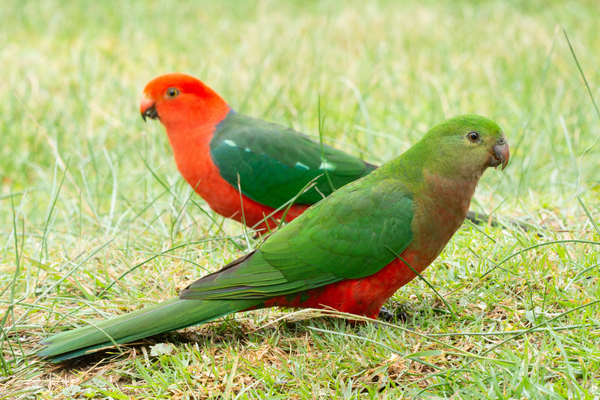
The male Australian King Parrot is one of the only birds in the world where the entire head is a brilliant, uniform scarlet red — a colouration that develops gradually through successive moults over the bird's first two years of life.

King Parrots are closely associated with tall wet eucalypt forest along the Great Dividing Range, but have expanded into suburban areas wherever mature trees are present — they are a familiar and beloved garden visitor in many eastern Australian cities.

Australian King Parrots are part of the genus Alisterus, shared with species from New Guinea and the Moluccas — the group is believed to represent a relatively early branch in the evolution of Australian parrots.

Keep them stimulated

Enrichment

King Parrots benefit from a naturalistic, stimulating environment. Fresh native branches — particularly eucalyptus, grevillea and bottlebrush — provide both perching variety and excellent foraging interest through leaves, flowers and gum nuts. Replace branches regularly with fresh cuts. Offer foraging toys, food presented in novel ways (wrapped in paper, threaded on skewers, hidden in foraging boxes), and rotate a range of chew toys, bells and swings.

Regular bathing is enjoyed by most King Parrots — offer a large, shallow water dish or a gentle misting spray. Exposure to natural, unfiltered sunlight through supervised outdoor access or an outdoor aviary supports health and natural behaviour. Providing perches at multiple heights and encouraging the bird to move between them supports healthy foot and leg condition.

What to watch for

Common Health Issues

Psittacosis (Chlamydiosis): Annual vet checks and good hygiene are preventative.

PBFD (Psittacine Beak and Feather Disease): Source from reputable, tested breeders.

Respiratory infections: Often linked to vitamin A deficiency; a varied diet with pellets reduces risk.

Obesity: King Parrots can become obese on seed-heavy, high-fat diets — ensure pellets form the dietary base and limit fatty seeds.

Bacterial infections: Can occur under poor hygiene conditions or when the bird is stressed.

Internal parasites: Annual faecal testing recommended, particularly for aviary birds.

Feather Destructive Behaviour: Uncommon but can develop with chronic boredom or insufficient enrichment.

Everything you need

Essentials Shopping List

Setup checklist

  • Medium-to-large cage or aviary — minimum 90 × 45 × 120 cm indoor cage; 3 mL × 1m W × 2m H outdoor aviary recommended
  • Multiple natural timber perches (eucalyptus, grevillea, bottlebrush, lilly pilly)
  • Food and water dishes (minimum two sets)
  • Quality medium parrot pellets
  • Quality small parrot seed mix
  • Bird grit (small amounts)
  • Cuttlebone and iodine bell
  • Vitamin supplement (a quality bird vitamin supplement)
  • Broad-spectrum bird wormer (quarterly)
  • Varied fresh fruit and vegetables (daily)
  • Rotating toys: chew items, foraging toys, swings, bells
  • Fresh native branch supply (eucalyptus, grevillea, bottlebrush)
  • Large shallow bathing dish or spray bottle
  • Breathable cage cover
  • Avian-safe cage disinfectant
  • Annual avian vet check (ongoing)
  • Fauna keeper licence (all states and territories)
FAQ

Commonly Asked Questions

  • How do I tell a male from a female King Parrot?

    Adult males have an entirely red head and upper breast; females and immature birds are predominantly green with a red lower belly. Full adult male colouration develops at approximately two years. Before this, DNA sexing is the most reliable method.

  • Are King Parrots good talkers?

    They can develop some speech but are not known as accomplished talkers — their appeal is more in their striking beauty and gentle character than in vocal mimicry.

  • Can King Parrots be kept in an outdoor aviary?

    Yes, and this is strongly recommended. King Parrots are active birds that thrive in a spacious outdoor aviary with access to natural sunlight and flight exercise.

  • Are King Parrots affectionate?

    Hand-raised birds can be very gentle and enjoy being near their owners, though they tend to be calmer and more reserved than species such as the Galah. They are rewarding in a quieter, more dignified way.

  • Do I need a licence to keep a King Parrot in Australia?

    Yes. A fauna keeper licence is required in all states and territories. Confirm requirements with your state wildlife authority before purchasing.

Need help?Our specialists are in-store every day to help with set up, licensing and feeding.

Visit Kellyville Pets