Care Guide6 min read

Hahn's Macaw

Diopsittaca nobilis nobilis
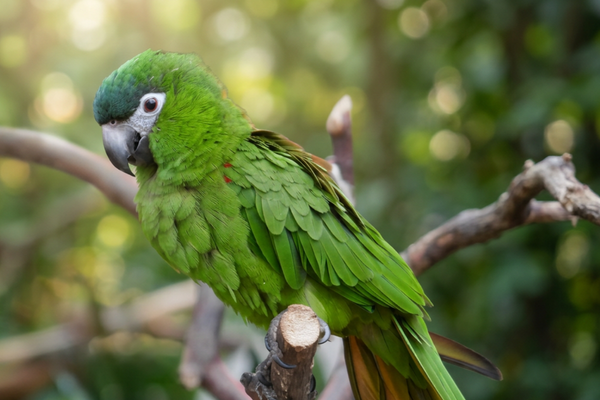
Mini Macaw · Red-shouldered Macaw · Noble Macaw (larger subspecies)

Hahn's Macaw Care Guide
Lifespan
20-30+ years
Adult Size
30cm; 160-165g
Care Level
Medium
Diet

Quality South American or medium parrot pellets as the dietary foundation, with daily fresh fruit, vegetables and limited seed and nuts

Enclosure

Medium powder-coated or stainless steel cage (minimum 100cm W x 75cm D x 165cm H) with natural timber perches, a play top and a robust rotating toy selection

Temperament

Characterful, playful, comically confident and deeply bonded to their owners — Hahn's Macaws bring full macaw personality in miniature form

Where they come from

Natural History & Origin

The Hahn's Macaw is native to a broad range of lowland tropical habitats in northern South America, including Venezuela, Trinidad, Guyana, Suriname and northern Brazil. They inhabit open savanna woodland, forest edges, gallery forest along watercourses, and swampland, where they live in flocks of 10–20 birds, foraging in the canopy for seeds, fruits, berries, nuts and blossoms.

The Hahn's Macaw holds a unique position in aviculture as the smallest of the macaw species — bringing macaw personality, intelligence and trainability in a significantly more manageable body size. Kellyville Pets describes it as the smallest macaw available, and it is the most popular of the miniature macaw group in Australia. Hand-raised birds can become outstandingly tame, enjoy learning tricks, and develop clear talking ability.

Hahn's Macaws are exotic (non-native) birds in Australia and no keeper licence is required. They must be sourced from legally captive-bred stock — importation of wild birds to Australia is prohibited.

Get it right early

Tips for First-Time Owners

  1. 1 While smaller than other macaws, the Hahn's Macaw still needs a genuinely large cage — minimum 100 x 75 x 165 cm — and one to two hours of out-of-cage time daily. The size a vet-recommended flea treatment over larger macaws is in housing practicality, not in time commitment.
  2. 2 A quality liquid calcium supplement calcium supplement at least three times per week is recommended in the first year.
  3. 3 Hahn's Macaws can be loud — while more manageable than large macaws, their calls are sharp and carry well. Consider this carefully for apartment or close-neighbour situations.
  4. 4 Positive reinforcement training is the most effective approach for this species and should begin from day one with step-up as the foundation behaviour.
  5. 5 Source from a reputable captive breeder in Australia — no specific keeper licence is required, but all birds must be legally captive-bred stock.
Setting up the habitat

Enclosure & Husbandry

Despite their small size for a macaw, Hahn's Macaws are active and acrobatic birds that need a well-appointed, genuinely spacious cage. A minimum cage size of 100cm W x 75cm D x 165cm H is recommended, with bar spacing of approximately 2–2.5 cm. Powder-coated or stainless steel construction is suitable. Open-top cage configurations with a play top are ideal for hand-raised birds, providing more freedom and interaction with the family.

Provide multiple sturdy natural timber perches of varying diameter — native timber species (eucalyptus, grevillea, bottlebrush, lilly pilly) provide beak conditioning and foraging interest as well as physical support. A dedicated play stand or gym outside the cage provides essential out-of-cage territory for the important daily out-of-cage time.

Place the cage in a main living area where the bird can participate in household activity. Cover partially at night with a breathable cover. Keep well away from kitchen fumes and non-stick cookware. Provide a minimum of six rotating toys including chew toys, foraging toys, foot toys, bells and swings. Hahn's Macaws are enthusiastic chewers and toys must be robust enough to withstand a macaw beak.

What to feed

Dietary Management

Hahn's Macaws should be fed a quality South American pellet — such as a quality South American parrot pellet or an equivalent medium parrot formulation — as the primary dietary component, constituting approximately 60–70% of total diet. Supplement daily with a variety of fresh fruit and vegetables, including apple (seeds removed), pear, mango, papaya, capsicum, corn, peas, broccoli, leafy greens, carrot and sweet potato. Remove fresh food within two to three hours.

Never feed avocado, chocolate, onion, garlic, fruit pips or seeds, caffeine, alcohol, or processed and salted human foods. A small quantity of quality parrot seed mix can be offered as a supplement. Nuts — almonds, walnuts, macadamias — are eagerly consumed and make excellent training treats in small quantities.

A quality calcium supplement such as a quality liquid calcium supplement should be provided at least three times per week, particularly for birds in their first year. Cuttlebone and iodine bells should always be available. Vitamin supplements such as a quality bird vitamin supplement can be added to water two to three times per week. Fresh water must be changed daily. Worming with a broad-spectrum bird wormer every three months.

Day-to-day interaction

Handling & Socialisation

They are bold, curious, and often self-assured to the point of cheekiness. They can be loud — their calls carry well and are sharper and more grating in quality than larger macaws — but are considerably more apartment-tolerant than full-sized macaw species.

Hahn's Macaws respond very well to positive reinforcement training and form strong bonds with consistent, attentive handling. Establish step-up, step-down and recall training as foundational safety behaviours from day one. Short, frequent training sessions of five to ten minutes using favoured treats — small pieces of nut, macadamia, almond — are highly effective.

Out-of-cage time of one to two hours daily is important for physical health and mental wellbeing. All household members should interact with the bird regularly to prevent strong single-person bonding, which can lead to aggression toward others. Hand-raised birds that are socialised broadly will seek interaction with multiple family members. Birds that are under-handled or isolated become loud, destructive and difficult — the investment in daily interaction is directly reflected in the temperament of the bird.

Did you know

Fun Facts

Despite being the smallest of all macaw species, the Hahn's Macaw is a true macaw in every functional sense — it possesses the same zygodactyl (two-toed forward, two-toed backward) feet used for food manipulation, the same powerful hooked beak, and the same capacity for complex learning and long-term bonding that characterises all macaw species.

Hahn's Macaws have been documented being cross-bred with closely related Conure species in some overseas collections — the resulting hybrid offspring (sometimes called 'maconures') demonstrate the surprisingly close evolutionary relationship between mini macaws and the larger conure group.

In the wild, Hahn's Macaws are known to nest in termite mounds as well as tree hollows — using the heat generated by active termite colonies to assist in egg incubation, a behaviour observed in very few parrot species globally.

Keep them stimulated

Enrichment

Hahn's Macaws need active daily enrichment appropriate to their macaw-level intelligence. Foraging enrichment is highly effective — hide food in foraging toys, wrap in paper, present in puzzle boxes or thread on skewers to encourage problem-solving. Rotate a selection of chew toys, puzzle feeders, foot toys, bells and swings every few days to maintain novelty. Provide fresh native branches from eucalyptus, grevillea and bottlebrush regularly — chewing is a fundamental behavioural need.

Trick training with positive reinforcement is one of the most engaging and effective enrichment activities for this species — Hahn's Macaws are quick learners and greatly enjoy the interaction. Teach step-up, wave, recall, and more complex behaviours progressively. Supervised out-of-cage play time with a dedicated gym provides important physical activity and social engagement.

What to watch for

Common Health Issues

Feather Destructive Behaviour: Can develop with insufficient social interaction, inadequate enrichment or underlying medical causes. Prevention is through consistent daily handling and environmental complexity.

Proventricular Dilatation Disease (PDD): A serious neurological and digestive viral disease; source from healthy, reputable breeders.

Psittacosis (Chlamydiosis): Annual vet checks and good hygiene are preventative.

Macaw Wasting Syndrome: A wasting condition associated with poor nutrition and chronic stress; balanced diet and regular vet checks are key preventative measures.

Respiratory infections: Often linked to vitamin A deficiency; a pellet-based diet reduces risk.

Obesity: Can develop with infrequent physical activity and excessive high-fat foods — ensure daily out-of-cage exercise.

Beak overgrowth: Can occur with inadequate chewing materials — provide regular native branches and appropriately sized chew toys.

Everything you need

Essentials Shopping List

Setup checklist

  • Medium powder-coated or stainless steel cage — minimum 100 x 75 x 165 cm
  • Open-top play area or dedicated gym/play stand
  • Multiple natural timber perches of varying diameter (eucalyptus, grevillea, bottlebrush)
  • Stainless steel food and water dishes (minimum two sets)
  • Quality South American or medium parrot pellets
  • Quality calcium supplement (a quality liquid calcium supplement — 3x per week in first year)
  • Varied fresh fruit and vegetables (daily)
  • Small parrot seed mix (supplement only)
  • Nuts (almonds, walnuts — training rewards)
  • Cuttlebone and iodine bell
  • Vitamin supplement
  • Broad-spectrum bird wormer (quarterly)
  • Minimum six rotating toys: chew toys, foraging toys, foot toys, bells, swings
  • Fresh native branches (ongoing supply)
  • Cage cover (breathable fabric)
  • Avian-safe cage disinfectant
  • Annual avian vet check (ongoing)
FAQ

Commonly Asked Questions

  • Is a Hahn's Macaw suitable for someone who has never kept a macaw before?

    Yes, more so than larger macaws. Their smaller size makes housing and handling more accessible. They do, however, have full macaw-level time and interaction requirements — they are not a low-maintenance bird.

  • Do Hahn's Macaws talk?

    Many do, and they can develop clear, contextually appropriate speech. They are considered good talkers for their size but should not be expected to match the vocabulary depth of an African Grey.

  • How noisy are Hahn's Macaws?

    Notably noisy — their calls are sharp, carry well, and are more grating in quality than the calls of larger macaws. They are considerably less disruptive than full-sized macaws but should not be considered quiet birds.

  • Can I keep two Hahn's Macaws together?

    A compatible bonded pair can cohabitate well, but each bird must still receive individual daily human interaction. Avoid keeping more than two in the same enclosure. Never house with significantly smaller bird species.

  • Do I need a licence to keep a Hahn's Macaw in Australia?

    No — Hahn's Macaws are exotic birds. No keeper licence is required, but all birds must be legally sourced from captive-bred stock within Australia.

Need help?Our specialists are in-store every day to help with set up, licensing and feeding.

Visit Kellyville Pets