Breed Guide6 min read

Birman

Sacred Cat of Burma · Sacred Birman

  • Affectionate
  • Easy to train
  • Apartment-friendly
  • Good with children
  • Calm temperament
  • Suitable for first-time owners
  • Low exercise needs
  • Good with other pets
Birman Breed Guide
Temperament

Calm, gentle and genuinely people-loving — the Birman follows its family from room to room, prefers to be near rather than alone, and communicates with soft chirps and quiet vocalisations rather than persistent meowing. Patient and tolerant with children and other animals. Intelligent without being demanding; curious without being destructive. Often described as dog-like in its loyalty.

Lifespan
12–16 years with good care; some individuals reach 18+ years
Adult Size
Medium to large. Males 4.5–7 kg; females 3–5.5 kg. Well-muscled and sturdy. Takes 3 years to reach full maturity.
Care Level
Low
Coat Type

Medium-long, silky, single-layer coat with no undercoat. Moderate shedder — the lack of a dense undercoat significantly reduces matting compared to other longhaired breeds. Not hypoallergenic.

Energy Level

Low to Medium. Playful but not hyperactive — content with interactive play sessions and quiet indoor life.

is this the right breed for you?

Owner Suitability

Excellent for families, first-time cat owners, retirees and households with children or other pets. One of the most broadly suitable of all pedigree cat breeds. Calm, tolerant and people-oriented without being demanding. Adapts readily to indoor living.

Where the breed comes from

Origin & History

The Birman's origin is steeped in legend — said to be the sacred temple cats of Burma, blessed by the goddess Tsun-Kyan-Kse to bear gold coats and white gloves as a mark of purity. Historical evidence points to France as the breed's modern origin, with the first documented Birman, Poupée de Madalpour, born in Nice in 1920. The breed nearly became extinct during World War II, with only two survivors known in Europe. Careful rebuilding of the gene pool, using Siamese and other longhaired breeds as outcrosses, produced the modern Birman. Recognised by major cat councils in Australia, the Birman is registered with the Australian Cat Federation (ACF) and similar bodies. All cats should be kept indoors in Australia due to wildlife predation risk and road safety.

Get it right early

Tips for First-Time Owners

  1. 1 Source from a breeder who cardiac-screens breeding cats by echocardiography and DNA-tests for PKD — both conditions are hereditary and testable before purchase.
  2. 2 Keep strictly indoors — Birmans are not streetwise, have no road awareness and are at serious risk from wildlife predation in Australia.
  3. 3 Provide a feline companion if the household is regularly absent — Birmans are social cats that do not thrive in isolation.
  4. 4 Monitor weight carefully throughout life — the Birman's lower energy level and indoor lifestyle make obesity a common and gradually developing issue.
  5. 5 Invest in pet insurance from the start — cardiac conditions and dental care can generate significant veterinary costs over a 12–16 year lifespan.
Daily Routine

Care & Exercise

The Birman is one of the most manageable of all pedigree breeds in terms of care. Their semi-long coat requires regular but not intensive grooming. They are highly social cats that do not tolerate long periods of isolation — if the household is away during the day, a companion cat is beneficial. Feed a quality, age-appropriate diet; Birmans are prone to obesity given their lower energy level. Portion control and regular weigh-ins are recommended. Annual veterinary checks including cardiac assessment and dental care are important. Keep strictly indoors in Australia.

Coat Care Routine

Grooming

Lower maintenance than most longhaired breeds given the absence of a dense undercoat. Brush two to three times per week with a soft slicker brush or wide-tooth comb to prevent tangles and remove loose hair — focusing on the ears, armpits and collar area where mats are most likely to develop. Bathe every six to eight weeks or as needed. Birmans often enjoy water and may accept bathing more readily than many breeds. Clean ears weekly. Brush teeth regularly. Trim nails every two to three weeks. Inspect the white paw 'gloves' regularly for staining.

Did you know

Fun Facts

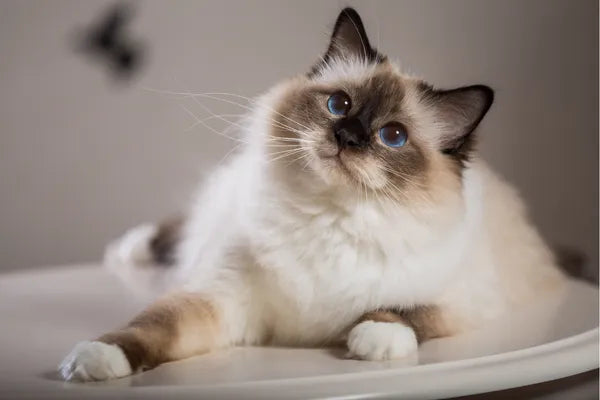
Birman kittens are born entirely white — completely without colour or markings — and develop their colourpoint pattern and white gloves progressively over the first few months of life. A Birman kitten's final colour may not be fully apparent until several months of age, making it one of the most dramatically transforming breeds in early life.

The Birman faced near-extinction during World War II — by the end of the conflict, only two cats were known to survive in Europe: Orloff and Xenia de Kaabaa. All modern Birmans descend from the careful reconstruction of the breed using outcrosses, primarily with Siamese and other longhaired breeds. The breed's survival is credited almost entirely to the efforts of French breeders in the post-war period.

The Birman's distinctive white gloves are the breed's most scrutinised feature in the show ring — the symmetry, extent and placement of the white on all four paws is an exacting standard. Perfect 'lacing' on the hind legs (white running evenly up the back of the leg) is considered one of the most difficult features to breed consistently.

Day-to-day interaction

Handling & Socialisation

Birmans are naturally gentle and socialise readily with patient introductions. They tolerate careful handling by children well and generally adapt to multi-pet households with gradual exposure. Encourage interactive play from kitten-hood to build confidence and maintain healthy weight. Avoid sudden loud environments; Birmans are sensitive to stress and prefer calm, stable home routines.

Keep them stimulated

Enrichment

Birmans are intelligent and benefit from daily engagement. Interactive play — wand toys, feather toys, and puzzle feeders — provides essential cognitive and physical stimulation. Rotating toys maintains interest. Birmans enjoy being near their owners; supervised outdoor access in an enclosed cat run or cat-proofed garden provides environmental enrichment beyond the indoor space. Window perches provide bird-watching and sun-seeking opportunities. A companion cat is beneficial for households where the cat is regularly home alone.

What to watch for

Common Health Issues

Hypertrophic Cardiomyopathy (HCM): The most significant hereditary concern — thickening of the heart muscle that can progress to heart failure. Cardiac screening (echocardiography) of breeding cats by registered cardiologists is recommended. Annual cardiac auscultation for all adults.

Polycystic Kidney Disease (PKD): Fluid-filled cysts in the kidneys; DNA testing is available and responsible breeders screen for this.

Obesity: Low energy level and indoor lifestyle make weight gain common. Portion control and regular weigh-ins throughout life are important.

Dental Disease: All cat breeds benefit from regular dental care; Birmans are not specifically more prone but dental hygiene is important.

Corn and tail staining: The white gloves and pale coat can show staining; keep paws and the litter tray clean.

Everything you need

Essentials Shopping List

Setup checklist

  • Quality adult cat food (age-appropriate; taurine-rich)
  • Stainless steel or ceramic food and water bowls
  • Water fountain (Birmans often enjoy running water)
  • Litter tray (one per cat plus one extra; covered or uncovered based on preference)
  • Quality clumping or crystal cat litter
  • Sisal or rope scratching post (tall; essential for claw health and stretching)
  • Cat tree or multi-level climbing structure
  • Window perch or cat shelf
  • Interactive wand toy and feather toys
  • Puzzle feeder or slow-feeder bowl
  • Soft slicker brush and wide-tooth comb
  • Nail clippers
  • Cat carrier (for vet visits)
  • Cat-proofed indoor environment or enclosed cat run
  • Pet insurance (from day one)
FAQ

Commonly Asked Questions

  • Is the Birman a high-maintenance coat breed?

    Less so than most longhaired breeds, because the coat has no undercoat and mats less readily. Brushing two to three times per week plus occasional bathing is generally sufficient. It is more manageable than a Persian or Maine Coon but more involved than a shorthaired breed.

  • Are Birmans good with children?

    Excellent — their patient, tolerant and gentle nature is one of their defining characteristics. They are among the most child-friendly of all pedigree cat breeds.

  • Do Birmans need a companion?

    Not mandatory, but strongly recommended for households where the cat will be regularly home alone. Birmans are social and do not cope well with extended isolation.

  • What does 'colourpointed' mean?

    The body colour is pale and the extremities — face mask, ears, legs and tail — are a darker matching colour. The contrast between body and points is a hallmark of the Birman. All Birmans also have white gloves on all four paws.

  • What health tests should I ask a breeder for?

    Cardiac clearance (echocardiography) and PKD DNA test for both parents.

Need help?Our specialists are in-store every day to help with sourcing, training and supplies.

Visit Kellyville Pets