


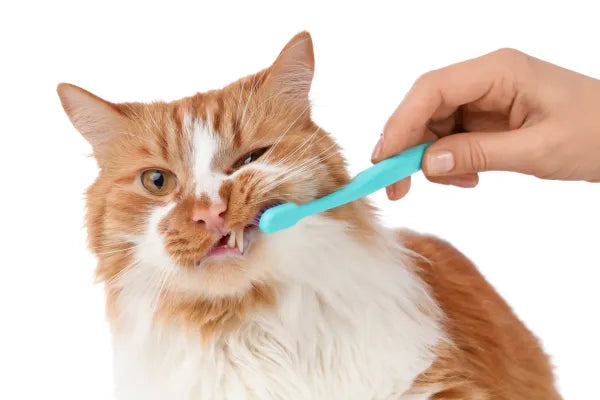
Cats are extraordinarily good at hiding pain. A cat with a mouth sore enough to need extractions will still finish dinner, still purr on your lap, still look completely fine. That is exactly why dental disease is the most common health problem we see walk through the door at Beaumont Hills, and the one owners are most often shocked by.
The good news is that the early stage is fully reversible, and the routine that prevents it takes about a minute a day. Here is what actually matters.
What goes wrong in a cat's mouth
Plaque, a soft bacterial film, starts building on teeth within hours of a clean. Minerals in saliva harden it into tartar within a couple of days, and tartar cannot be brushed off. Bacteria then work into the gap between tooth and gum, the immune system responds with inflammation, and that inflammation slowly destroys the ligament and bone holding the tooth in place. That is periodontal disease.
Cats also get two problems dogs largely do not:
Tooth resorption, where the body's own cells break down the tooth from the inside out. It is painful, it is common, and there is no way to prevent it. The only treatment is extraction.
Gingivostomatitis, a severe immune-driven inflammation of the whole mouth. Affected cats often drool, drop food, or stop grooming.
Neither is caused by poor brushing, and neither can be brushed away. If your cat's mouth suddenly changes, that is a vet visit, not a routine problem.
What a healthy mouth looks like
Lift the lip once a week. It takes five seconds and it is the single most useful habit you can build.
| What you see | What it means | What to do |
|---|---|---|
| Pale pink gums, white teeth, neutral breath | Healthy | Keep the routine going |
| Thin red line where gum meets tooth | Gingivitis, still reversible | Start or tighten the daily routine, book a check |
| Yellow-brown build-up, redder gums, noticeable smell | Established disease | Vet appointment, a professional clean is likely |
| Gums pulling back, wobbly or missing teeth, drooling, blood | Advanced | Vet promptly, this is painful now |
| Pawing at the mouth, dropping food, chewing on one side | Pain, cause unclear | Vet, do not wait it out |
Bad breath is the one people dismiss. "Cat breath" is not a thing. It is the smell of bacteria.
The routine, ranked by what actually works
Not every option is equal, and the marketing does not sort them for you.
| Method | How much it does | Daily effort |
|---|---|---|
| Brushing with pet toothpaste | Most effective by a clear margin | 30-60 seconds |
| Dental diet (VOHC-accepted) | Strong, and it replaces a meal you were feeding anyway | None |
| Dental treats or chews (VOHC-accepted) | Moderate, useful as a top-up | Seconds |
| Water additives and gels | Modest, better than nothing | Almost none |
| Regular dry food | Minimal, the kibble shatters rather than scrapes | None |
Look for the Veterinary Oral Health Council (VOHC) seal on Australian shelves. It means the product has been tested to actually reduce plaque or tartar, rather than just being labelled "dental".
Brushing, done properly
Use a soft cat toothbrush or a finger brush, and pet toothpaste only. Never human toothpaste: ours contains fluoride cats should not swallow, and many varieties contain xylitol, which is listed on Australian labels as xylitol, birch sugar, or E967 and is not safe for pets. Pet toothpaste is enzymatic, safe to swallow, and flavoured like poultry or malt, so most cats treat it as food.
The outer surfaces of the upper back teeth are where tartar collects. You do not need to open the mouth or reach the inner surfaces. Angle the brush at the gum line, small circles, finish while your cat is still calm.
If your cat will not tolerate a brush at all, that is genuinely common and there is a full non-brushing routine that works. See our guide on dental care for cats who will not tolerate a toothbrush.
A word on anaesthesia-free dental cleaning
You will see this advertised, sometimes at markets or grooming salons, sometimes framed as the safer choice for older cats. It is not.
Scaling only removes what you can see above the gum line. The disease that destroys the tooth happens below it, and reaching that on a conscious cat is impossible. Dental x-rays, which are the only way to spot tooth resorption or a failing root, cannot be taken on a moving animal either. What you get is a cat that has been restrained while sharp instruments were used in its mouth, and teeth that look cleaner while the actual problem continues untouched.
The Australian Veterinary Association and the American Veterinary Dental College both advise against it. If cost or anaesthetic risk is the worry, talk to your vet about it directly, because modern protocols with pre-anaesthetic bloods and monitoring are far safer than most owners assume, including for senior cats.
The professional clean, and what it costs
A proper dental means a general anaesthetic, a full charted examination, dental x-rays, ultrasonic scaling above and below the gum line, polishing, and extractions if needed.
Costs vary considerably between practices, and extractions are the main variable. In Sydney, a straightforward scale and polish sits well below the cost of a dental that turns into multiple extractions, and quotes commonly run into four figures once extractions are involved. Ask your vet for a written estimate with and without extractions before the day.
On insurance: most Australian pet policies exclude routine dental cleaning entirely. Some cover dental illness as an optional add-on, usually with a waiting period and often on the condition that you have had annual dental checks and followed the advice given. Read the product disclosure statement before you assume you are covered, and check whether pre-existing conditions have already been noted on your cat's file.
Start with kittens
A kitten who has had a fingertip in its mouth since twelve weeks will accept a toothbrush for life. This is the easiest dental win available and it costs nothing. Handle the muzzle daily, lift the lips, make it boring and unremarkable, and add toothpaste once it is a non-event.
The short version
Lift the lip weekly. Brush if you can, and use a VOHC-accepted diet or treat if you cannot. Treat bad breath as a symptom rather than a personality trait. Skip anaesthesia-free cleaning entirely. And get a proper look at the mouth at every annual vet visit, because your cat will never tell you.
August is Dental Month at Kellyville Pets. Bring your questions in and our Cat department team will walk you through what suits your cat, or have a look at what we have put together for the month.


