


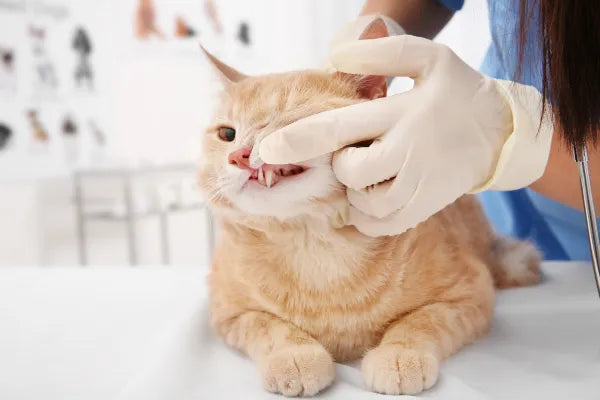
You bought the little brush. You read that you should do it daily. You got one paw to the wrist, a look of genuine betrayal, and a cat who now leaves the room when you open that drawer. So you stopped.
That is the normal outcome, not a personal failure. Plenty of cats will never accept a toothbrush, and the answer is not to give up on their mouth. It is to build a routine out of the things they will accept.
First, check it is not pain
Before anything else: if your cat used to tolerate having its mouth handled and now does not, that change is information. Cats with tooth resorption or gingivostomatitis will flinch, chatter their jaw, or pull away hard when a specific spot is touched, and no amount of patient training will fix that. Other signs are drooling, dropping food, chewing on one side, or a sudden drop in grooming.
If any of that sounds like your cat, book a vet appointment before you start a training plan. You cannot desensitise your way out of a sore tooth.
The honest ranking
Every option below beats doing nothing. None of them fully replaces brushing, and it is worth being upfront about that rather than pretending otherwise.
| Option | Realistic benefit | Effort | Worth it? |
|---|---|---|---|
| Finger and gauze | Close to brushing on the outer surfaces | 30 seconds | Best non-brush option |
| Dental wipes or finger pads | Good, easier than gauze for most owners | 30 seconds | Yes |
| VOHC-accepted dental diet | Strong, and replaces food you already buy | None | Yes, highest value per effort |
| VOHC-accepted dental treats | Moderate, a genuine top-up | Seconds | Yes, within calorie limits |
| Dental gel applied to the gum line | Modest to moderate | 15 seconds | Yes, if your cat allows a finger |
| Water additive | Modest | Almost none | Only as an extra layer |
| Regular dry food | Minimal, the kibble shatters rather than scrapes | None | No, this is a myth |
Look for the Veterinary Oral Health Council (VOHC) seal. It is the only shortcut that tells you a product was actually tested to reduce plaque or tartar rather than just marketed as dental.
Step down the ladder, don't jump off it
Most cats reject a toothbrush because the brush arrived at step ten. Working back to step one usually gets you further than abandoning the whole idea. Give each step a week or so, keep sessions under thirty seconds, and stop while your cat is still relaxed rather than pushing until they pull away.
| Week | What you are doing |
|---|---|
| 1 | Stroke the muzzle and cheeks during a normal cuddle. Nothing enters the mouth. Treat afterwards. |
| 2 | Lift one lip for a second, let go, treat. One side per session. |
| 3 | Dip a fingertip in pet toothpaste or tuna water and let your cat lick it off. Nothing else. |
| 4 | Run that fingertip along the outer surface of the upper back teeth on one side. Two or three seconds. |
| 5 | Wrap the finger in gauze or use a dental wipe. Same movement, same length. |
| 6 | Both sides, still using gauze. This is a complete routine. Stay here if you like. |
The upper back teeth on the outside are where tartar builds. You do not need to open the mouth, and you do not need to reach the inner surfaces, because the tongue does a reasonable job there. If you never get past week six, you are still doing most of the available good.
Never use human toothpaste. Ours contains fluoride cats should not swallow, and many varieties contain xylitol, which appears on Australian labels as xylitol, birch sugar, or E967 and is not safe for pets. Pet toothpaste is enzymatic, safe to swallow, and flavoured like poultry or malt, which is what makes step three work.
Dental diets do the heavy lifting
If your cat tolerates nothing at all, this is where to put your effort. A dental diet is not just bigger kibble. The pieces are engineered to hold together as the tooth passes through, so the tooth is wiped rather than crunching straight through into fragments, and most contain a compound that binds calcium in saliva to slow tartar forming.
They are complete diets, not toppers, so they replace what you currently feed rather than adding to it. Speak to us or your vet about which is appropriate, particularly if your cat has kidney, urinary, or weight considerations, because a dental formula is not automatically the right pick for every cat.
Treats, gels and additives
Dental treats work on the same principle and are the easiest thing in this article to actually do. Keep them inside the usual limit of no more than about 10% of daily calories, and reduce meals slightly to compensate, or you will trade a dental problem for a weight one.
Dental gels are applied to the gum line with a fingertip and left to work, with no brushing required. If your cat gets to week three of the ladder above and no further, a gel is a good use of that access.
Water additives are the lowest effort option and the most modest in effect. Some cats are put off by the change to their water, which matters more than the dental benefit does, since cats are prone to drinking too little as it is. If yours turns their nose up, drop it and keep the fresh water flowing.
What to skip
Dry food as a dental strategy. Standard kibble shatters on contact and contributes little. This one is stubbornly persistent and simply is not true.
Bones, antlers and hard chews. Cats do not chew the way dogs do, and hard items risk fractured teeth. Raw chicken necks come up a lot in conversation and carry real fracture, obstruction and bacterial risks, so treat it as a question for your vet rather than general advice.
Anaesthesia-free dental cleaning. Sometimes marketed as the gentle option for cats who hate handling, which makes it especially tempting here. Scaling only reaches above the gum line, while the disease that destroys teeth happens below it, and dental x-rays cannot be taken on a conscious cat. You get a restrained cat, teeth that look better, and a problem that carries on underneath. Both the Australian Veterinary Association and the American Veterinary Dental College advise against it.
A realistic routine for a difficult cat
| When | What |
|---|---|
| Every day | Dental diet as the main food |
| Every day | One VOHC-accepted dental treat, counted into daily calories |
| A few times a week | Gauze wipe or dental gel on the upper back teeth, one side per session |
| Weekly | Lift the lip and look at the gum line |
| Annually | Full oral exam at the vet, more often if anything looks off |
That is a genuinely good standard of care, and there is not a toothbrush in it.
August is Dental Month at Kellyville Pets. If you are not sure which diet or treat suits your cat, bring the question in and our Cat department team will talk it through with you.


