Breed Guide6 min read

Ragdoll

Raggy

  • Good with children
  • Affectionate
  • Apartment-friendly
  • Easy to train
  • Suitable for first-time owners
  • Good with other pets
  • Low exercise needs
  • Calm temperament
Ragdoll Breed Guide
Temperament

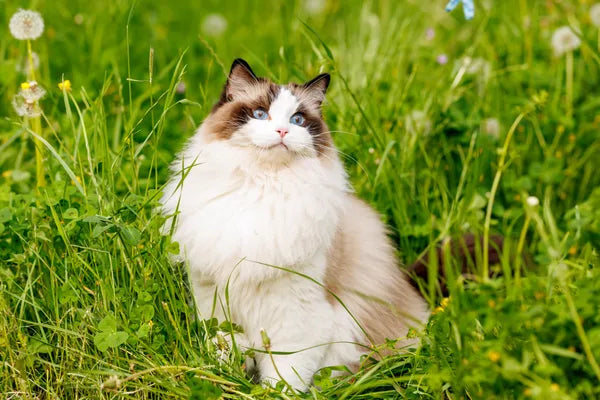
The Ragdoll lives up to its name — these cats genuinely relax and go limp when picked up, making them exceptional for gentle handling. Deeply people-oriented and famously dog-like in their devotion; they follow their owners from room to room, greet at the door and enjoy being involved in daily life. Non-aggressive, rarely scratch or bite and tolerant of handling that many cats would resist. Gentle, quiet and calm — ideally suited to relaxed household environments.

Lifespan
12–17 years with good care; some individuals reach 18–20 years
Adult Size
Very large. Males 6–9 kg; females 4–6.5 kg. One of the largest domestic cat breeds. Takes 3–4 years to reach full size and maturity.
Care Level
Low to Medium
Coat Type

Semi-long, plush, silky coat. Moderate to heavy shedder — the plush coat sheds regularly. Requires consistent grooming. Not hypoallergenic. The coat has minimal undercoat compared to many longhaired breeds, reducing (but not eliminating) matting.

Energy Level

Low to Medium. Gentle and playful but not high-energy — content with moderate interactive play.

is this the right breed for you?

Owner Suitability

Excellent for families, first-time cat owners, households with children, retirees and those seeking a gentle, calm companion. One of the most broadly suitable pedigree breeds. The substantial size and coat commitment should be assessed before purchase.

Where the breed comes from

Origin & History

The Ragdoll is one of the youngest recognised cat breeds, developed in Riverside, California in the 1960s by breeder Ann Baker, who began with a white domestic longhaired cat named Josephine. Baker selectively bred for large size, colourpointed coats, blue eyes, and a characteristic relaxed, 'floppy' temperament when handled — the trait that gave the breed its name. Baker's breeding programme and the resulting Ragdoll breed were controversial; she established her own registry and made extraordinary claims about the breed's origin. The breed has since been developed and refined by other breeders globally. Ragdolls were introduced to Australia where they rapidly became one of the most popular pedigree breeds. Registered with the ACF and equivalent bodies. Keep strictly indoors in Australia.

Get it right early

Tips for First-Time Owners

  1. 1 HCM is the defining health concern of this breed — source only from a breeder who echocardiographically cardiac-screens breeding cats and DNA-tests for the Ragdoll-specific MYBPC3 HCM mutation. This is non-negotiable.
  2. 2 Never allow a Ragdoll unsupervised outdoor access — their extraordinary trust of people and lack of traffic awareness make them extremely vulnerable. Their trusting temperament is a genuine safety risk outdoors.
  3. 3 Establish a grooming routine from kittenhood — a young Ragdoll that learns to enjoy brushing becomes a cooperative adult. An ungroom-conditioned adult Ragdoll is challenging to manage.
  4. 4 Monitor weight carefully throughout life — Ragdolls are large cats with placid personalities and larger appetites. Obesity is common and reduces lifespan and quality of life.
  5. 5 Invest in pet insurance from day one — HCM management and cardiac monitoring over a potential 15+ year lifespan can be a significant financial commitment.
Daily Routine

Care & Exercise

The Ragdoll is a manageable breed in terms of temperament and energy, but the coat requires consistent grooming commitment. Feed a quality diet in measured portions — Ragdolls are prone to obesity given their large size, placid temperament and lower activity level. HCM cardiac screening of breeding cats is critical given the breed's documented predisposition. Annual veterinary checks including cardiac assessment and dental care are important. Keep strictly indoors — Ragdolls are particularly naive around traffic and strangers given their extremely trusting temperament.

Coat Care Routine

Grooming

More involved than the coat's appearance might suggest. Brush three to four times per week with a wide-tooth comb and soft slicker brush to manage shedding and prevent tangles — particularly in the longer feathering on the chest, legs and tail. Daily brushing during seasonal moults. The coat does not mat as readily as some other longhaired breeds due to limited undercoat, but tangles develop behind the ears and in the armpits without regular attention. Bathe every six to eight weeks. Clean ears weekly. Brush teeth regularly. Trim nails every two to three weeks.

Did you know

Fun Facts

The Ragdoll's defining characteristic — the tendency to relax completely and go limp when picked up, like a ragdoll — is a genuine heritable temperament trait rather than a trained behaviour. Research suggests it may be related to a lower-than-average pain sensitivity or a different physiological response to restraint. It is the primary trait that breeder Ann Baker selected for when establishing the breed in the 1960s.

The Ragdoll HCM MYBPC3 mutation is one of the few breed-specific cardiac gene variants to have been identified, characterised and tested for in any domestic animal species — a significant achievement in feline veterinary genetics that has directly enabled more targeted health screening in the breed.

Ragdolls are one of the largest domestic cat breeds in the world by average weight — a fully grown male can weigh 9 kg, approaching the size of a small dog. Despite this, they are among the most gentle and least aggressive of all cat breeds — the combination of great size with great gentleness is what makes them so uniquely well-suited to family and multi-pet households.

Day-to-day interaction

Handling & Socialisation

One of the easiest cat breeds to handle and socialise given their extraordinarily tolerant, trusting nature. They are excellent with children precisely because of their gentle, non-reactive disposition. Introduce other pets gradually; their non-aggressive temperament means they are sometimes at a disadvantage in multi-pet households with more assertive animals — monitor early interactions. Their extreme trust of people means they must be kept indoors; they will approach strangers, including those with ill intent, without fear.

Keep them stimulated

Enrichment

Despite their laid-back reputation, Ragdolls need and enjoy daily play. Interactive wand toys, feather toys and gentle fetch games are appropriate. A large, sturdy cat tree provides essential climbing and resting opportunities for a breed of this size. Puzzle feeders help prevent obesity. Window perches provide safe outdoor stimulation. Ragdolls often enjoy the company of other cats and can thrive in pairs. Rotate toys to maintain interest.

What to watch for

Common Health Issues

Hypertrophic Cardiomyopathy (HCM): The most critical hereditary health concern — the Ragdoll has one of the highest documented rates of HCM of any cat breed. A specific genetic mutation (MYBPC3 variant) associated with HCM has been identified in the breed; DNA testing for this variant is available and recommended. Echocardiographic screening of breeding cats by a registered cardiologist is strongly recommended. Annual cardiac auscultation for all adults; echocardiography as recommended.

Polycystic Kidney Disease (PKD): Less common than in Persians but documented; DNA testing available.

Feline Infectious Peritonitis (FIP): Ragdolls may have a higher susceptibility than some breeds; keep strictly indoors and away from unknown cats.

Obesity: Common given the placid temperament and large appetite; measure all meals.

Bladder Stones: Reported in the breed; ensure adequate water intake.

Everything you need

Essentials Shopping List

Setup checklist

  • Quality large-breed adult cat food (age-appropriate; calorie-controlled)
  • Stainless steel or ceramic food and water bowls
  • Water fountain
  • Litter tray (large; one per cat plus one extra)
  • Quality clumping or crystal cat litter
  • Tall, sturdy sisal scratching post
  • Large, heavy cat tree with wide platforms (Ragdolls are big)
  • Window perch (reinforced for weight)
  • Interactive wand toys and feather toys
  • Puzzle feeder (important for weight management)
  • Wide-tooth comb and soft slicker brush
  • Nail clippers
  • Cat carrier (large)
  • Strictly indoor cat-proofed environment
  • Pet insurance (from day one — HCM monitoring makes this essential)
FAQ

Commonly Asked Questions

  • Do Ragdolls really go limp when picked up?

    Yes — it is a genuine heritable temperament trait that most Ragdolls display to some degree. They relax when lifted and tolerate handling that most cats would resist. It is one of their most endearing characteristics.

  • Are Ragdolls suitable for families with young children?

    Exceptionally so. Their non-aggressive, tolerant and patient temperament makes them one of the best cat breeds for families with children of any age.

  • Do Ragdolls cope alone during the day?

    Better than some highly social breeds, but they do benefit from companionship. A second cat provides significant enrichment.

  • How serious is HCM in Ragdolls?

    Very — the breed has one of the highest documented rates of HCM of any cat breed. Annual cardiac monitoring and sourcing from echocardiographically-screened breeding cats are the most important health commitments.

  • What health tests should I ask a breeder for?

    MYBPC3 HCM DNA test (specific to Ragdolls) AND echocardiographic cardiac screening; PKD DNA test.

Need help?Our specialists are in-store every day to help with sourcing, training and supplies.

Visit Kellyville Pets