


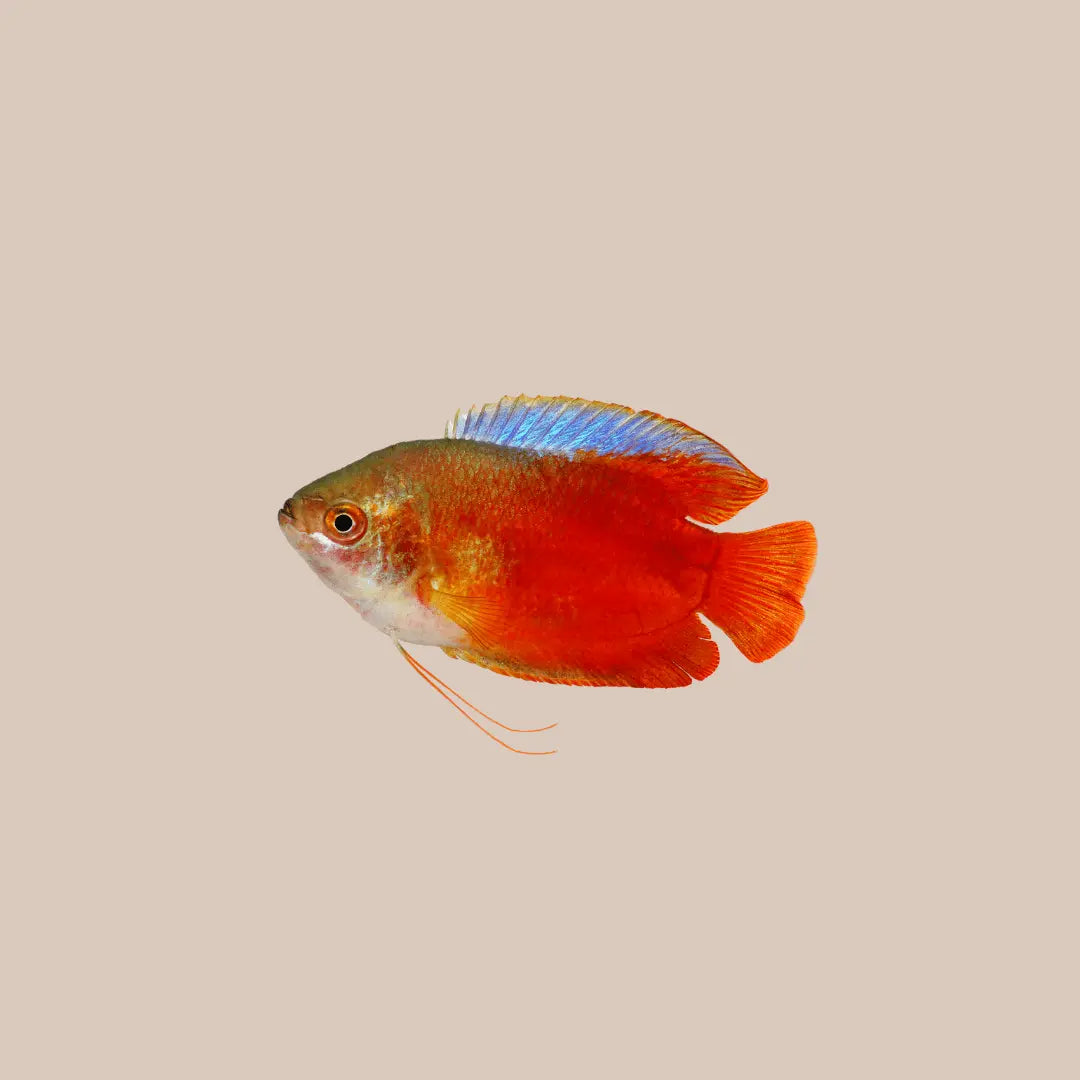
Dwarf Gourami
Trichogaster lalius
Download the full care guide (PDF)
Free & Print-ready

4-5 years

4-6cm

Low to Medium


Where they come from
Natural History & Origin


Get it right early
Tips for First-Time Owners
- 1 Quarantine every new fish for two to four weeks before adding it to the main tank — this is the most important DGIV prevention step. A simple quarantine tank (20–40 litres, sponge filter, heater) protects an entire established aquarium.
- 2 Watch the male's colour daily — a previously vivid male turning dull or grey is communicating a problem. Test water quality first; assess feeding and stress factors second.
- 3 Only one male per tank under 100 litres — male territorial conflict is one of the most common causes of stress and injury in this species.
- 4 Floating plants are functional, not decorative — surface cover reduces light stress, provides bubble nest anchoring and produces visibly more active, confident fish.
- 5 Always maintain an air gap between the water surface and the tank lid — the labyrinth organ requires atmospheric air access and a sealed surface causes breathing difficulty.
Setting up the habitat
Enclosure & Husbandry
What to feed
Dietary Management
Day-to-day interaction
Handling & Socialisation
Find your next best friend
Browse all Freshwater Fish
Our Available Freshwater Fish


Did you know
Fun Facts
The labyrinth organ of the Dwarf Gourami is a folded, highly vascularised chamber in the head cavity that functions similarly to a primitive lung — extracting oxygen from atmospheric air inhaled at the surface. This adaptation is so effective that Dwarf Gouramis can survive in oxygen-depleted water where virtually all other fish suffocate — an extraordinary evolutionary response to the stagnant, heavily vegetated waterways of South Asia.
Male Dwarf Gouramis build elaborate bubble nests — rising to the surface to gulp air, blowing each bubble individually and coating it with saliva to increase durability, then arranging the mass beneath floating plants. After spawning the male collects fertilised eggs in his mouth and places each one into the nest, then guards it aggressively until fry are free-swimming — one of the more dedicated examples of paternal care in freshwater fish.
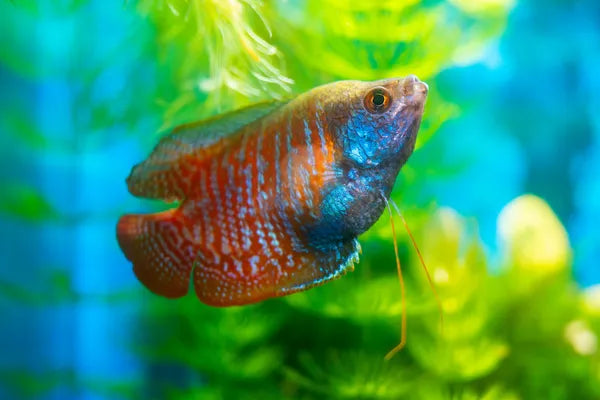
The iridescent colouration of the Dwarf Gourami is achieved not through pigment alone but through structural coloration — the microscopic layering of scale surfaces refracts light to produce the characteristic metallic shimmer. This is the same optical mechanism responsible for the colours of butterfly wings and hummingbird feathers, and explains why the colouration shifts and changes with the angle of light.
Keep them stimulated
Enrichment
What to watch for
Common Health Issues
Everything you need
Essentials Shopping List
Setup checklist
- Aquarium (minimum 60 litres; 80–100 litres preferred)
- Aquarium hood or lid (with air gap above waterline — essential)
- Sponge filter or low-flow internal filter
- Aquarium heater (adjustable; 24–28°C)
- Thermometer
- Water quality test kit (ammonia, nitrite, nitrate, pH)
- Dechlorinator / water conditioner
- Dark substrate — black or brown sand or fine gravel
- Floating plants (frogbit, water sprite, dwarf water lettuce)
- Mid-water live plants (java fern, anubias, stem plants)
- Driftwood or smooth rocks
- LED aquarium light (adjustable intensity preferred)
- Quality small tropical pellets or micro-pellets
- Quality small flake food
- Frozen daphnia, bloodworm and brine shrimp
- Small soft aquarium net
- Gravel vacuum / siphon
- Quarantine tank (20–40 litres; sponge filter; heater)
- Aquarium-safe algae scraper
READY TO SET UP
Browse all
Shop the Essentials

Save 30%
Seachem Prime
from$12.99
View →

Aqua One Glass Heater
from$29.99
View →

Seachem Stability Tank Starter
from$12.99
View →

API Tap Water Conditioner
from$11.99
View →

Fluval 07 Series Canister Filter
from$199.00
View →

Aqua One Aquis Series II Filter
from$169.00
View →

Air Line Per Meter
$1.99
View →

Ocean Nutrition Instant Baby Brine Shrimp - 20g
$36.99
View →
FAQ
Commonly Asked Questions
-
Can I keep two male Dwarf Gouramis together?
-
What is DGIV and how do I avoid it?
-
Why has my male Dwarf Gourami lost colour?
-
Do Dwarf Gouramis need a heater?
-
Are Dwarf Gouramis suitable for a community tank?
Learn more
See more care guides Read about other species
No articles match that search. Try a different word.


Need help?Our specialists are in-store every day to help with set up, licensing and feeding.
Visit Kellyville Pets