


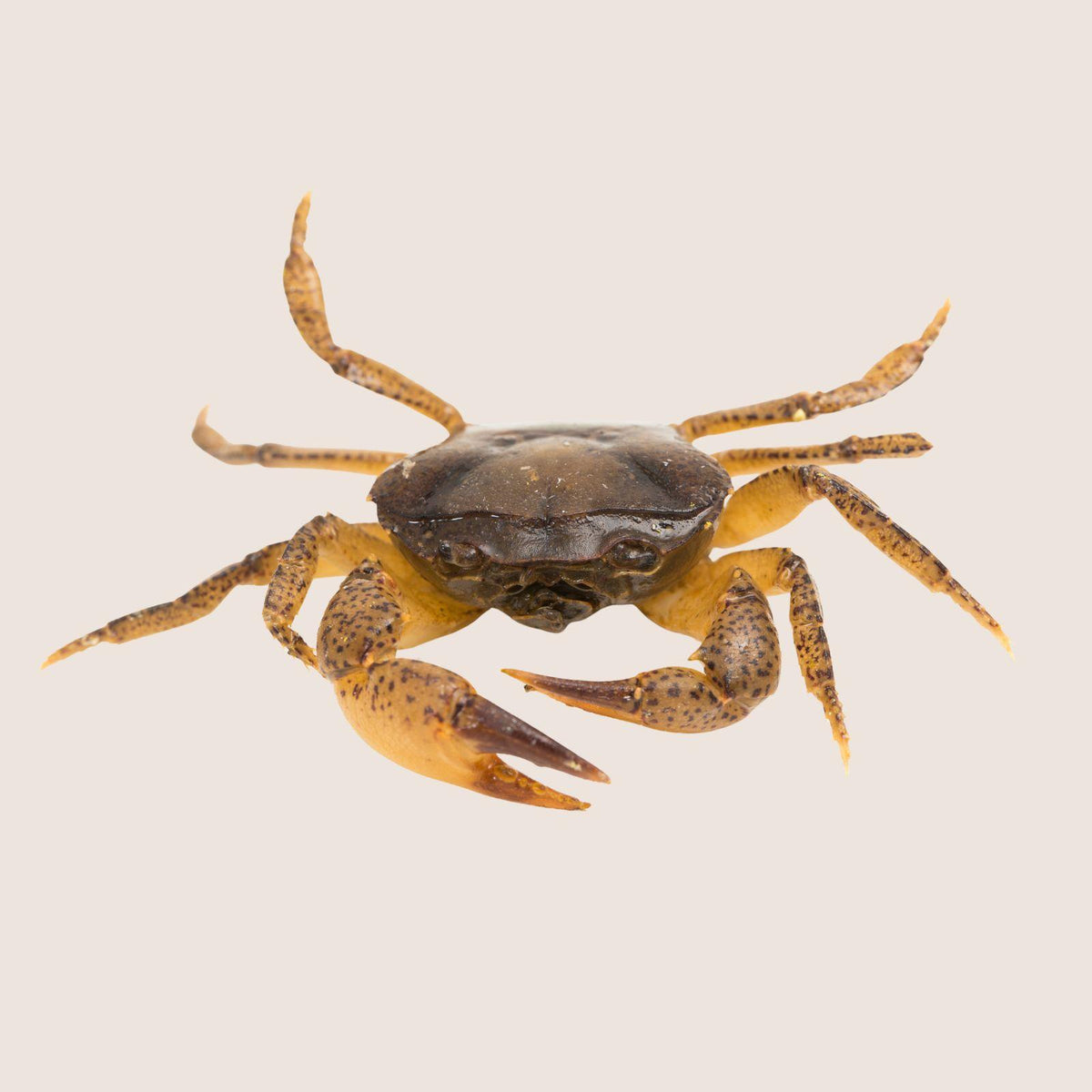
Freshwater Crab
Austrothelphusa agassizi
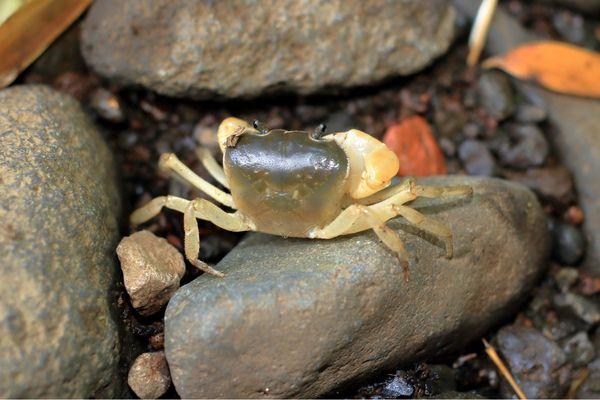
Download the full care guide (PDF)
Free & Print-ready

5-8 years

40mm carapace width

Medium


Where they come from
Natural History & Origin


Get it right early
Tips for First-Time Owners
- 1 A completely escape-proof lid is the single most important enclosure feature: A. agassizi is an active climber and explorer that will exploit any gap. Weight or clip the lid.
- 2 Provide both water and land access at all times: this species is amphibious and must be able to leave the water voluntarily.
- 3 Calcium must be permanently available: a cuttlebone section in the enclosure and calcium-rich foods support healthy moulting and claw integrity.
- 4 Never handle a recently moulted crab: the new exoskeleton is extremely soft and fragile for several days after moulting.
- 5 Confirm current licensing requirements in your state before purchasing: as a native Australian invertebrate, A. agassizi may require a basic fauna permit in some states.
Setting up the habitat
Enclosure & Husbandry
What to feed
Dietary Management
Day-to-day interaction
Handling & Socialisation
Find your next best friend
Browse all Aquatic Pets
Our Available Aquatic Pets


Did you know
Fun Facts
Austrothelphusa agassizi is one of the few freshwater crab species whose distribution crosses the continental divide of north Queensland — its range encompasses both eastward-draining rivers flowing to the Coral Sea and westward-draining rivers flowing toward the Gulf of Carpentaria, implying that at some point in geological history, the low-lying base of Cape York was either a single connected watercourse or a landscape wet enough for the species to move between catchments.
Like all Austrothelphusa species, A. agassizi undergoes direct development: eggs hatch as miniature fully formed crabs rather than passing through a planktonic larval stage. The female carries the clutch of large eggs under her abdominal flap throughout development, providing protection until the young crabs are capable of independent life — a reproductive strategy shared with all gecarcinucid freshwater crabs worldwide.
The genus name Austrothelphusa means 'southern Thelphusa' — Thelphusa being the original 19th century genus in which Australian freshwater crabs were first placed. The Austrothelphusa genus is entirely endemic to Australia and represents the continent's only radiation of the globally diverse family Gecarcinucidae, which contains over 1,300 described species in tropical Asia and Africa.
Keep them stimulated
Enrichment
What to watch for
Common Health Issues
Everything you need
Essentials Shopping List
Setup checklist
- Aqua-terrarium or modified aquarium (min. 60×40×40 cm; 100 L recommended for pairs)
- Escape-proof lid with clip or weight fastening
- Land-to-water ramp or slope
- Land section substrate (8–12 cm): sand, fine gravel or sand-coco peat mix
- Cork bark, smooth rocks and PVC pipe sections (hides on land)
- Low-flow sponge or internal filter (water section)
- Aquarium heater and thermostat (water section; 20–28°C)
- Thermometer
- Water quality test kit (ammonia, nitrite, nitrate, pH, hardness)
- Water conditioner / dechlorinator (copper-neutralising)
- Crushed cuttlebone (permanent calcium supplement)
- Quality sinking crustacean or shrimp pellets
- Blanched vegetables (zucchini, carrot, spinach, sweet potato)
- Dried shrimp and earthworms (protein supplements)
- Gravel siphon / small turkey baster (water section maintenance)
- Soft container for transfers (never handle post-moult)
READY TO SET UP
Browse all
Shop the Essentials

Seachem Prime
from$12.99
View →

Aqua One Glass Heater
from$29.99
View →

Seachem Stability Tank Starter
from$12.99
View →

API Tap Water Conditioner
from$11.99
View →

Aqua One Aquis Series II Filter
from$169.00
View →

Fluval 07 Series Canister Filter
from$199.00
View →

Hikari Algae Wafers
from$8.49
View →

Ocean Nutrition Instant Baby Brine Shrimp - 20g
$36.99
View →
FAQ
Commonly Asked Questions
-
Does A. agassizi need both water and land access?
-
Can I keep A. agassizi with fish?
-
How do I tell A. agassizi apart from Holthuisana sp. (Brown Back Crab)?
-
Do I need a licence to keep A. agassizi in Australia?
-
How do I tell males from females?
Learn more
See more care guides Read about other species
No articles match that search. Try a different word.


Need help?Our specialists are in-store every day to help with set up, licensing and feeding.
Visit Kellyville Pets