Care Guide6 min read

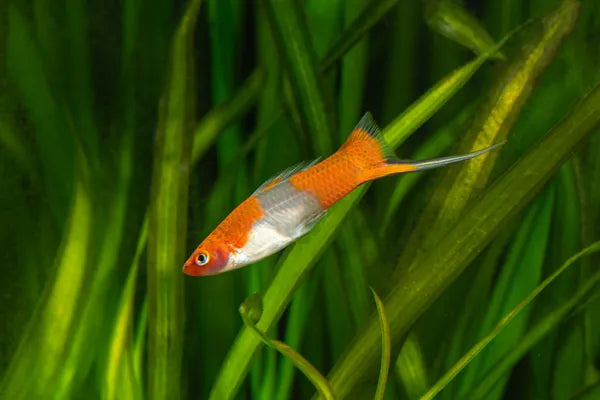
Santa Swordtail

Xiphophorus hellerii

Santa Claus Swordtail · Koi Swordtail · Kohaku Swordtail · Green Swordtail (wild-type parent)

Santa Swordtail Care Guide
Lifespan
3–5 years with good care
Adult Size
Males: body 6–8 cm plus sword extension up to 5–8 cm. Females: 8–12 cm
Care Level
Low
Diet

Omnivore: quality tropical flakes or small pellets as the staple; supplement with frozen brine shrimp, daphnia and bloodworm; include vegetable matter; feed small amounts twice daily

Enclosure

Minimum 80 litres; longer tank preferred (90 cm+); well-oxygenated; 22–28°C; pH 7.0–8.0; SECURE LID essential - excellent jumpers

Temperament

Active, colourful and generally peaceful toward other species. Males are competitive toward each other - displaying, chasing and occasionally fighting - particularly in smaller tanks.

Where they come from

Natural History & Origin

Xiphophorus hellerii is native to fast-flowing, well-oxygenated streams, rivers and springs of Central America - primarily eastern Mexico, Guatemala, Belize and Honduras. Wild water is typically moderately hard and neutral to slightly alkaline.

The Green Swordtail entered the aquarium hobby in the early 20th century and became one of the foundational livebearer species alongside Guppies, Mollies and Platies. Decades of selective breeding have produced an enormous range of colour and fin varieties - the Santa or Koi Swordtail being one of the most striking.

Get it right early

Tips for First-Time Owners

  1. 1 Install a fully secure, tight-fitting lid before the fish arrive - Swordtails are exceptional jumpers and will use any gap.
  2. 2 Maintain at least two to three females per male - persistent male harassment is the most common source of chronic stress and reduced female lifespan.
  3. 3 Be prepared for fry - Swordtails breed readily and females can store sperm from a single mating for several births. Use a breeding box or dense floating plants if fry survival is desired.
  4. 4 Avoid Tiger Barbs and Serpae Tetras - the Swordtail's long sword is a fin-nipping target and repeated attacks cause injury and chronic stress.
  5. 5 Do not be alarmed by sex reversal - a female developing male characteristics (sword extension, gonopodium) is undergoing a documented biological sex change. This is normal and not a sign of poor health.
Setting up the habitat

Enclosure & Husbandry

A minimum of 80 litres (approximately 90 cm long) for a small group. A longer footprint is preferred - Swordtails are active, streamlined swimmers.

CRITICAL: A fully secure, tight-fitting lid is non-negotiable. Swordtails are exceptional jumpers - among the most jump-prone of all commonly kept freshwater fish. Any gap will eventually be used.

Water parameters: temperature 22–28°C; pH 7.0–8.0 (neutral to slightly alkaline - unlike most South American species); hardness 10–25 dGH (moderately hard is preferred). Weekly 25–30% water changes.

Filtration: hang-on-back or internal filter with moderate water movement - Swordtails originate from fast-flowing streams and appreciate better water movement than most community fish.

Plants and decor: live or artificial plants, particularly floating plants, provide cover for females and fry. Dense planting or a breeding box provides fry refuge from adult fish if fry survival is desired.

What to feed

Dietary Management

Santa Swordtails readily accept a wide range of foods. A quality tropical flake or small pellet should form the dietary staple; supplement with frozen or live brine shrimp, daphnia and bloodworm two to three times per week for best colour and breeding condition.

Vegetable matter is important: blanched spinach, zucchini, peas and spirulina-based flakes or wafers provide the plant component of the natural diet and support digestive health. Swordtails will graze algae from tank surfaces if available.

Feed small amounts twice daily - only what the fish consume in two to three minutes. Swordtails are active mid-water and surface feeders.

Day-to-day interaction

Handling & Socialisation

Fish are not handled - all management is environmental.

Excellent companions: Platies, Mollies, Guppies and other livebearers; Corydoras catfish; Tetras of appropriate size (not tiny species like Neon Tetras); Danios and Rasboras; peaceful Barbs (Cherry, Gold); Bristlenose Plecos.

Avoid: fin-nipping species (Tiger Barbs, Serpae Tetras - the sword is a target); very small fish that may be harassed or eaten; highly aggressive or territorial species; fish requiring soft, acidic water incompatible with the Swordtail's neutral-alkaline preference. Male competition is manageable with the right stocking ratio but can cause injury in overcrowded setups.

Did you know

Fun Facts

The Swordtail is one of the very few vertebrates in which natural spontaneous sex reversal from female to functional male is well documented and studied. Mature females that have reproduced can develop a gonopodium and sword extension and function as fertile males - making Xiphophorus species subjects of ongoing genetics and evolutionary biology research.

The Swordtail's 'sword' is not simply decorative - research has shown that females actively prefer males with longer swords as mating partners, a genuinely sexually selected trait under female mate choice pressure. Longer swords signal male genetic quality.

Xiphophorus species have been used as model organisms in cancer research - they develop a specific form of melanoma in certain hybrid individuals. This research has contributed to understanding the genetic basis of melanoma in humans, making the Swordtail one of the few aquarium fish to have played a meaningful role in biomedical science.

Keep them stimulated

Enrichment

Open mid-water swimming space combined with planted areas and hiding structures provides physical enrichment and security for less dominant individuals.

Varied feeding - rotating flake, frozen foods and vegetable matter - mimics natural omnivorous foraging. Occasional live food (daphnia, baby brine shrimp) provides hunting stimulation.

Breeding behaviour itself is enrichment: observing courtship, the male's sword display and the birth of live fry is one of the most rewarding experiences in livebearer keeping. Floating plants give fry an immediate refuge and the keeper the opportunity to observe fry development from birth.

What to watch for

Common Health Issues

Ich: White spots on body and fins. Treatable with temperature elevation to 28–30°C and standard Ich treatments.

Fin Rot: Bacterial erosion of the fins - particularly a concern for the male's sword. Caused by water quality decline or fin-nipping tank mates. Improve water quality; treat with antibacterial medication if advanced.

Velvet (Oodinium): Fine gold dust on body and fins. Treat promptly in a hospital tank.

Female Overbreeding Stress: Constant male pursuit causes chronic stress in females. Maintain at least two to three females per male and provide dense planting for female refuge.

Jumping Injuries: The most common preventable welfare issue. A fish found on the floor may still recover if returned to water promptly. A secure lid is non-negotiable.

Everything you need

Essentials Shopping List

Setup checklist

  • Aquarium (minimum 80 litres; 90 cm+ length preferred)
  • Fully secure, tight-fitting lid (essential)
  • Hang-on-back or internal filter (moderate flow)
  • Aquarium heater (22–28°C)
  • Thermometer
  • Water quality test kit (ammonia, nitrite, nitrate, pH)
  • Dechlorinator / water conditioner
  • Gravel or sand substrate
  • Live or artificial plants (floating plants for fry cover)
  • Driftwood or smooth rocks
  • LED aquarium light and timer
  • Quality tropical flake or small pellet food
  • Spirulina flakes or algae wafers
  • Frozen brine shrimp, daphnia and bloodworm
  • Breeding box (if fry survival desired)
  • Fine soft aquarium net
  • Gravel vacuum / siphon
  • Aquarium-safe algae scraper
FAQ

Commonly Asked Questions

  • Do Santa Swordtails breed easily?

    Yes - readily in most community setups. Females can store sperm from a single mating and produce multiple batches of fry without further male contact. Maintain a single-sex group if breeding is not desired.

  • Why does my female Swordtail look like a male?

    Natural sex reversal - females can develop male characteristics including the sword and gonopodium. A normal biological phenomenon; the fish can become a functional male.

  • How do I tell male from female?

    Males are smaller, more slender, have the sword extension and a modified anal fin (gonopodium). Females are larger, deeper-bodied, no sword and a normal fan-shaped anal fin.

  • Are Santa Swordtails aggressive?

    Males can be competitive toward each other but peaceful toward other species. The correct female-to-male ratio (2–3 females per male) manages competition and female harassment.

  • Why do I need a tight lid?

    Swordtails are among the strongest jumpers of all commonly kept freshwater fish. A fish found on the floor may still recover if returned to water promptly.

Need help?Our specialists are in-store every day to help with set up, licensing and feeding.

Visit Kellyville Pets