


Blue and Gold Macaws have been documented using tools in captive research settings — a reflection of their considerable cognitive complexity and problem-solving capacity.
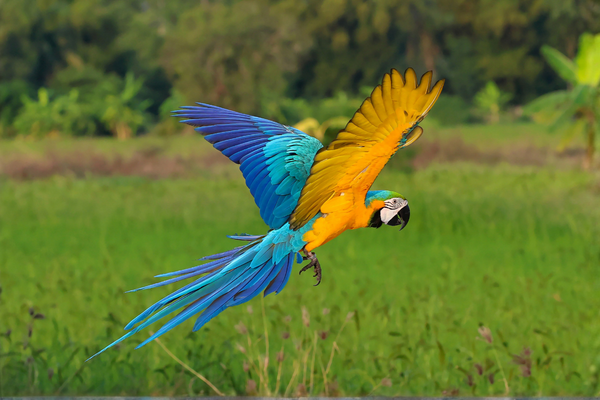
Blue and Gold Macaw
Ara ararauna
Download the full care guide (PDF)
Free & Print-ready

50-60+ years

76-86cm; 900-1,300g

High


Where they come from
Natural History & Origin

Get it right early
Tips for First-Time Owners
- 1 The size, noise level and daily time requirement of a Blue and Gold Macaw should not be underestimated — two to four hours of daily direct interaction is a minimum, not an aspiration.
- 2 Invest in the largest, most robust cage you can accommodate — a macaw in an inadequately sized cage is a welfare failure that no amount of good diet or enrichment can compensate for.
- 3 All locks, latches and cage fittings must be macaw-proof — Blue and Golds are highly intelligent and will learn to open standard cage latches with surprising speed.
- 4 Confirm that all cage materials, toys and accessible household surfaces are free of zinc and lead — heavy metal toxicity is a serious and preventable health risk.
- 5 Confirm exotic bird requirements in your state, source only from reputable captive breeders, and establish a relationship with an experienced avian vet before acquiring your bird.
Setting up the habitat
Enclosure & Husbandry
What to feed
Dietary Management
Day-to-day interaction
Handling & Socialisation
Find your next best friend
Browse all Handraised Birds
Our Available Handraised Birds
Did you know
Fun Facts
Their powerful beak can exert over 300 pounds of force per square inch — enough to crack large, hardshelled nuts including Brazil nuts and hard palm fruits that no other bird can access.
Wild Blue and Gold Macaws engage in geophagy — eating mineral-rich clay from exposed riverbank cliffs — to neutralise toxins present in seeds and unripe fruits that form part of their natural diet. Large flocks gathering at clay licks are one of the most spectacular wildlife sights in the Amazon Basin.
Keep them stimulated
Enrichment
What to watch for
Common Health Issues
Everything you need
Essentials Shopping List
Setup checklist
- Very large powder-coated or stainless steel cage — minimum 175 × 75 × 200cm; walk-in aviary preferred
- Macaw-proof locking mechanism on all cage doors
- Heavy-duty natural timber perches (minimum 3–5 cm diameter), multiple
- Large dedicated play stand / gym
- Stainless steel heavy-duty food and water dishes (minimum two sets)
- High-quality large macaw pellets
- Varied fresh fruit, vegetables and cooked legumes (daily)
- Nuts (walnuts, almonds, macadamias) — for training rewards
- Cuttlebone and iodine bell
- Vitamin supplement (a quality bird vitamin supplement)
- Broad-spectrum bird wormer (quarterly)
- Minimum eight to ten large heavy-duty rotating toys: chew blocks, foraging toys, puzzle feeders, swings
- Large softwood chew blocks and dried native timber branches (ongoing)
- Heavy-duty foraging boxes and skewers
- Cage cover (large, breathable)
- Avian-safe disinfectant
- Annual avian vet check (ongoing)
READY TO SET UP
Browse all
Shop the Essentials

Avigrain Wild Bird Mix 20kg
$28.49
View →

Avigrain Small Parrot Mix 20kg
$36.49
View →

Avigrain Budgie Blue 20kg
$52.99
View →

Budgie Mix
from$15.99
View →

Forage Gourmet Eclectus Food
from$32.99
View →

Forage Pinecone Bird Treat
from$21.49
View →

Save 10%
Vetafarm Parrot Essentials

Forage Gourmet Conure & Quaker Food
from$17.99
View →
FAQ
Commonly Asked Questions
-
How much noise do Blue and Gold Macaws make?
-
Do Blue and Gold Macaws talk?
-
Can a Blue and Gold Macaw hurt someone?
-
How much space does a Blue and Gold Macaw need?
-
Do I need a licence for a Blue and Gold Macaw in Australia?
Learn more
See more care guides Read about other species
No articles match that search. Try a different word.


Need help?Our specialists are in-store every day to help with set up, licensing and feeding.
Visit Kellyville Pets